
Research guide
KLOW vs GLOW: One Extra Peptide, Two Very Different Research Blends
KLOW and GLOW share three of four compounds. The difference is 10mg of KPV, and whether that fourth research axis belongs in your work. A direct comparison.
Put a vial of GLOW next to a vial of KLOW and you would struggle to tell them apart. Same blue-tinged powder, same three core peptides, almost the same weight. The entire difference between them is a single ingredient: ten milligrams of a three-amino-acid peptide called KPV. And yet that one addition changes the story the blend tells, shifting it from a repair-focused formula to one that also brings inflammation signalling into the frame.
This guide explains exactly what is inside each blend, where each of the four peptides came from, what the published research on each one has explored, and how to decide which blend fits a particular research question. Both blends are supplied by Crown Peptides for laboratory research use only.
What Is Actually in Each Vial?
Let us start with the facts, because the names can make the blends sound more mysterious than they are.
GLOW is a 70mg blend containing three peptides: GHK-Cu 50mg, BPC-157 10mg and TB-500 10mg.
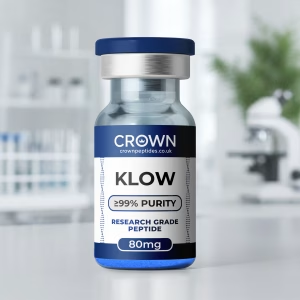
KLOW is an 80mg blend containing four peptides: GHK-Cu 50mg, BPC-157 10mg, TB-500 10mg and KPV 10mg.
So KLOW is GLOW plus KPV. Nothing about the other three ingredients changes. That makes this one of the cleanest comparisons in the whole research catalogue: any difference between the two blends in an experiment comes down to one molecule.
Where do the names come from?
GLOW has become the popular name for the GHK-Cu, BPC-157 and TB-500 combination, reflecting the skin and tissue research interest in its headline ingredient, GHK-Cu. KLOW simply adds a K for KPV, the peptide that makes it different. You will also see KLOW described as the KLOW stack or KLOW blend; all of these describe the same four-peptide, 80mg formulation.
How do they relate to the Wolverine Stack?
Searches for “KLOW vs GLOW vs Wolverine” are common, and the relationship is simple. The Wolverine Stack (BPC-157 + TB-500 Blend) contains just BPC-157 and TB-500. GLOW adds GHK-Cu to that pair. KLOW adds KPV on top of GLOW. Think of them as three steps on the same ladder: Wolverine is the repair core, GLOW adds a copper peptide with a broad skin and tissue research profile, and KLOW adds an anti-inflammatory signalling peptide.
Meet the Four Peptides
To understand the blends, you have to understand their ingredients. Each of the four has a genuinely interesting origin story, and each brings something different.
GHK-Cu: the copper peptide found in young blood
In 1973, a researcher named Loren Pickart was studying why liver tissue from older people behaved differently from liver tissue from younger people. He found that something in the blood plasma of younger individuals made older liver cells behave more like young ones. That something turned out to be a tiny peptide: glycine, histidine and lysine, three amino acids with a strong natural attraction to copper. It was named GHK, and the copper-bound form, GHK-Cu.
Plasma levels of GHK are notably higher in younger people and decline with age, which helped make it one of the most studied molecules in skin and tissue ageing research. In a 2018 review in the International Journal of Molecular Sciences, Pickart and Margolina summarised a remarkably broad research profile (PMID: 29986520, PMC6073405). Research has indicated that GHK may stimulate blood vessel and nerve outgrowth, increase collagen, elastin and glycosaminoglycan synthesis, and support the function of dermal fibroblasts, with tissue repair effects reported in models of skin, lung connective tissue, bone, liver and stomach lining. The review also highlighted gene expression data suggesting GHK influences a large number of genes across multiple biochemical pathways, which may explain why one small molecule turns up in so many different research contexts.
GHK-Cu is the dominant ingredient in both blends by weight, at 50mg per vial. You can also study it on its own as GHK-Cu, and our GHK-Cu research guide goes much deeper.
BPC-157: the peptide from gastric juice
BPC stands for Body Protection Compound. BPC-157 is a 15-amino-acid sequence derived from a protein found in human gastric juice, developed and studied for decades by Predrag Sikirić and colleagues at the University of Zagreb. It is notable for being unusually stable, including in the harsh environment of the stomach, which is why the Zagreb group often calls it the stable gastric pentadecapeptide.
A 2021 review in Frontiers in Pharmacology by Seiwerth, Sikirić and colleagues focused on BPC-157 in wound healing models (PMID: 34267654, PMC8275860). The review covered incisional and excisional wounds, deep burns, diabetic ulcer models and alkali burns in rats, and described effects on the vascular stages of healing. It also noted that BPC-157 rapidly increases the expression of various genes in rat skin wound models, and linked this to healing observed across a wide range of tissues in animal research, including the gastrointestinal tract, tendon, ligament, muscle, bone, nerve, cornea and blood vessels.
BPC-157 is available on its own as BPC-157, with a full background in our BPC-157 guide.
TB-500: built on the body’s actin regulator
TB-500 is based on thymosin beta-4, a small protein first characterised in the thymus gland by Allan Goldstein’s research group. Thymosin beta-4 turned out to be present in almost every cell in the body, where its main job is regulating actin, the protein that forms the internal scaffolding cells use to change shape and move.
A 2010 review in the FASEB Journal by Sosne, Goldstein and colleagues described how thymosin beta-4’s different biological activities map onto specific short regions of the protein (PMID: 20179146). Its central actin-binding region, including the sequence LKKTETQ, was linked to promoting angiogenesis (new blood vessel formation), wound healing and cell migration, while another region containing the sequence Ac-SDKP was linked to cell survival. That actin-binding and cell migration profile is why TB-500 is so often studied alongside BPC-157.
You can find it as TB-500, and our TB-500 guide explains its history in full.
KPV: the anti-inflammatory tail of a hormone
KPV is the ingredient that separates the two blends, and it has a fascinating lineage. It is a three-amino-acid peptide, lysine, proline and valine, that forms the very end of alpha-melanocyte-stimulating hormone (alpha-MSH). Alpha-MSH is the 13-amino-acid hormone best known for stimulating melanin production and skin pigmentation, but researchers found that it also has anti-inflammatory activity, and much of that activity appeared to be concentrated in its final three amino acids.
That made KPV an attractive research tool: it seemed to carry the anti-inflammatory signal of alpha-MSH without its pigmentation effects. A landmark 2008 study in Gastroenterology by Dalmasso, Merlin and colleagues investigated how it works (PMID: 18061177, PMC2431115). Nanomolar concentrations of KPV inhibited activation of NF-kappaB and MAP kinase inflammatory signalling pathways and reduced pro-inflammatory cytokine secretion in human intestinal epithelial cells and immune cells. The team showed KPV enters cells through PepT1, a transporter for small peptides that is found in the small intestine and becomes more active in the colon during inflammation. In two mouse models of colitis, KPV given in drinking water reduced the incidence of colitis and lowered pro-inflammatory cytokine expression.
KPV is available on its own as KPV, and our KPV guide and KPV and psoriasis research article explore its research in more depth.
- Classification
- 80 mg multi-peptide research blend containing GHK-Cu 50 mg, BPC-157 10 mg, TB-500 10 mg and KPV 10 mg
So What Does KPV Actually Change?
Here is where the comparison gets interesting. GLOW’s three ingredients share a common theme: they are studied primarily in the context of tissue repair, remodelling and regeneration. Research has indicated that GHK-Cu may increase collagen synthesis and support fibroblast function. BPC-157 has been shown in animal wound models to support healing, including its vascular stages. And research on thymosin beta-4 indicates it may promote cell migration and new blood vessel growth. They are, broadly, builders.
KPV is different. It is not primarily studied as a builder. Research has shown it can calm inflammatory signalling, specifically by inhibiting NF-kappaB, one of the master switches that turns on inflammatory genes inside cells.
Why inflammation and repair belong in the same conversation
Healing and inflammation are deeply intertwined. In any injury, an inflammatory phase comes first: immune cells arrive, clear debris and release signals that kick off repair. That phase is essential. But when it is excessive or fails to resolve, inflammation can slow or disrupt the rebuilding that should follow. Much of modern wound biology is about the transition from the inflammatory phase to the proliferative and remodelling phases.
That is the scientific logic behind KLOW. By pairing three peptides that research indicates may support rebuilding tissue with one shown to dampen inflammatory signalling, KLOW is designed for research questions that span both sides of that transition. GLOW keeps the focus on the repair and remodelling side alone.
A neat mechanistic overlap
There is a satisfying bit of shared biology here too. The Pickart review noted that GHK has been found to suppress NF-kappaB, which the review described as a molecule thought to accelerate the diseases of ageing. KPV’s best-characterised effect is also on the NF-kappaB pathway. So KPV does not introduce an entirely foreign mechanism into the blend; it adds a second, more targeted input into a pathway GHK-Cu is already linked to.
Mapping Four Peptides Onto the Four Stages of Healing
The easiest way to see why these particular peptides were grouped together is to lay them over the timeline biologists use to describe how tissue repairs itself. Wound healing is usually divided into four overlapping stages, and each peptide in KLOW has research interest concentrated in a different part of that sequence.
Stage one: stopping the bleeding
Within minutes of an injury, blood vessels constrict, platelets gather into a plug, and a mesh of fibrin forms to hold the plug in place. This stage is called haemostasis. It is where BPC-157’s research profile begins. The 2021 Frontiers in Pharmacology review described BPC-157 in rat wound models acting on vessel constriction, the platelet plug, the fibrin mesh and resolution of the clot, and drew a parallel with the Zagreb group’s work on bleeding and clotting disorders in animal models. Few research peptides have been studied this early in the healing sequence.
Stage two: the inflammatory response
Next, immune cells such as neutrophils and macrophages arrive to clear bacteria and debris and to release the signals that direct everything that follows. This is where KPV fits. Research has shown it inhibits NF-kappaB, the switch that drives production of inflammatory cytokines, and reduces those cytokines in cell and animal models. It is also where the difference between the two blends is most visible, because GLOW has no dedicated ingredient aimed at this stage and KLOW does.
Stage three: rebuilding
Over the following days, new tissue starts to form. Fibroblasts lay down fresh collagen, new blood vessels sprout into the area to supply it, and cells migrate in to close the gap. This proliferative stage is the heartland of the blend. TB-500’s research interest in cell migration and angiogenesis, via thymosin beta-4’s actin-binding region, sits squarely here. So does GHK-Cu’s association with collagen and glycosaminoglycan synthesis, fibroblast support, and blood vessel outgrowth described in the Pickart review. BPC-157, too, is studied here for its effects on vessel growth and tissue formation.
Stage four: remodelling
Finally, over weeks and months, the hastily built new tissue is reorganised. Collagen fibres are realigned and strengthened, and excess material is broken down. GHK-Cu is the ingredient most associated with this stage in the literature, reflecting its long history in skin research on collagen and extracellular matrix, and its links in gene expression data to tissue remodelling pathways.
What the map shows
Laid out this way, the logic of both blends becomes much clearer. GLOW covers the early vascular stage through BPC-157 and concentrates heavily on rebuilding and remodelling through all three of its peptides. KLOW keeps all of that and adds dedicated coverage of the inflammatory stage in between. Neither blend is a random collection of popular compounds; each is a deliberate spread across a well-understood biological process, and the only question is how much of that process a particular study needs to include.
KLOW Research Peptide
HPLC and MS verified · batch certificate published · dispatched from the UK before 2pm
KLOW vs GLOW: Choosing for a Research Question
With the ingredients understood, the decision becomes much more straightforward. It comes down to whether inflammatory signalling is part of the question you are asking.
When GLOW makes sense
GLOW suits research centred on tissue repair, remodelling and skin biology, where inflammatory signalling is not a variable of interest or is being controlled for in other ways. Its focus on GHK-Cu, with BPC-157 and TB-500 in support, makes it a natural fit for models involving collagen and extracellular matrix, fibroblast behaviour, angiogenesis and wound closure. It also offers a simpler system with fewer active variables, which can be an advantage in its own right.
When KLOW makes sense
KLOW suits research where the inflammatory environment is part of the question: models where tissue repair happens against a background of heightened inflammatory signalling, or where the interaction between NF-kappaB activity and repair processes is of interest. Because KPV’s most prominent research is in intestinal models, KLOW is also frequently discussed in the context of gut-related research alongside its skin and tissue applications.
Using the two as a matched pair
There is a third option that more research teams could make use of. Because KLOW is exactly GLOW plus 10mg of KPV, the two blends form a natural experimental pair. Run the same model with GLOW and with KLOW, and any difference in outcome points directly to the contribution of KPV in the context of the other three peptides. That is a far cleaner design than comparing two unrelated formulations.
What about GHK-Cu on its own?
Searches for “GLOW vs GHK-Cu” come up often. The single peptide is the right choice when the research question is specifically about GHK-Cu, its copper chemistry, gene expression effects or skin biology, without the other peptides as variables. Our comparison GHK-Cu vs Glutathione and our article on AHK-Cu vs GHK-Cu explore single-compound copper peptide research further.
The Technical Breakdown: What the Ratios Really Mean
This section is for readers who want to look under the bonnet. If you are happy with the big picture, you can skip ahead.
Weight versus number of molecules
Blend labels list each ingredient by weight in milligrams. But peptides vary enormously in size, so equal weights can mean very different numbers of molecules. Chemists count molecules in moles, and converting the label amounts into moles reveals a very different picture of what is in the vial.
Using approximate molecular weights, the numbers work out like this:
- GHK-Cu, at roughly 400 g/mol, means 50mg is about 125 micromoles.
- KPV, at roughly 342 g/mol, means 10mg is about 29 micromoles.
- BPC-157, at roughly 1,419 g/mol, means 10mg is about 7 micromoles.
- TB-500, based on thymosin beta-4 at roughly 4,960 g/mol, means 10mg is about 2 micromoles.
So although KPV makes up only one eighth of KLOW by weight, it contributes around four times as many molecules as BPC-157 and more than ten times as many as TB-500. GHK-Cu, meanwhile, dominates both blends in molecule count as well as weight. This is not a flaw in the formulation; it reflects the very different concentrations at which each peptide is typically studied. But it is useful context for anyone designing an experiment or interpreting results.
Three molecule-level details worth knowing
Why KPV works at such low concentrations
The Dalmasso study found KPV effective at nanomolar concentrations in cell culture, meaning billionths of a mole per litre. Its uptake via PepT1, the same transporter that brings dietary di- and tripeptides into gut cells, gives it a direct route inside the cell rather than relying on a surface receptor. That efficient entry is part of why such a small amount can register in cell-based assays.
Copper chemistry and colour
GHK binds copper(II) ions with high affinity, forming a complex in which the histidine and the peptide backbone coordinate the metal. Copper(II) complexes absorb light in the orange-red part of the spectrum, which is why GHK-Cu solutions and both blends take on a blue tint when reconstituted. That colour is a normal, expected sign that the copper complex is present.
Four peptides, four sets of chemistry
From an analytical point of view, a four-component blend is considerably more demanding than a single peptide. Each ingredient behaves differently on an HPLC column and has its own mass signature. GHK-Cu brings the added dimension of the copper ion. A proper certificate for a blend needs to identify each component, not just report a single overall purity number.
Why Blend Quality Is Harder to Get Right
Making a single high-purity peptide is a precise job. Making a four-peptide blend at specified ratios is harder still, and the quality considerations multiply.
First, each of the four peptides has to be made and purified to a high standard before it is combined. An impurity in any one of them becomes an impurity in the blend. Second, the proportions have to be accurate. A blend described as containing 10mg of KPV that actually contains 7mg, or 13mg, changes the experiment. Third, the peptides must be compatible when lyophilised together, remaining stable in the same vial through storage and shipping.
The Crown Peptides approach
Every batch of GLOW and KLOW supplied by Crown Peptides is accompanied by a batch-specific certificate of analysis. HPLC analysis separates and measures the components, and mass spectrometry confirms the identity of each peptide by its molecular mass. The lot number on the certificate matches the lot number on the vial. Our published certificates are available on the Lab Reports page, and our guide to reading a certificate of analysis explains what to look for with multi-component products.
Reconstituting a blend
Blends are handled much like single peptides: allowed to reach room temperature, reconstituted slowly down the side of the vial, and swirled gently rather than shaken. The key difference is in the arithmetic. Each component’s concentration has to be calculated separately from its own labelled amount. For example, reconstituting KLOW in 4ml gives 12.5mg/ml of GHK-Cu and 2.5mg/ml each of BPC-157, TB-500 and KPV. Our guide to peptide reconstitution and the peptide calculator make this straightforward, and Bacteriostatic Water is available alongside both blends.
Related Compounds and Neighbouring Blends
GLOW and KLOW sit at the centre of a cluster of related research compounds. If either blend is on your list, these are the neighbours worth knowing.
The single ingredients
Every component is available individually for researchers who want to isolate its contribution: GHK-Cu, BPC-157, TB-500 and KPV.
The Wolverine Stack
The Wolverine Stack (BPC-157 + TB-500 Blend) is the two-peptide repair core that both GLOW and KLOW build on. Read more in the Wolverine Stack research guide and BPC-157 vs TB-500.
AHK-Cu
AHK-Cu is a close relative of GHK-Cu, with alanine in place of glycine, studied particularly in hair follicle research.
LL-37
For researchers interested in KPV’s immune angle, LL-37 is a natural counterpart: an antimicrobial peptide the body makes itself, studied on the immune system’s “attack” side where KPV sits on the calming side. Our article LL-37 vs KPV sets out the contrast.
Research bundles built on the same ideas
The Dermal & Cellular Research Bundle and the Gastrointestinal Research Bundle bring together compounds for those research areas in separate vials. You can browse the wider tissue biology research peptides category for more.
Read the certificate before you order
Every batch is published openly — identity by mass spectrometry, purity by HPLC, and the batch number printed on the vial you receive.
Open the COA libraryKLOW and GLOW Questions, Answered
What is the difference between KLOW and GLOW?
KLOW contains everything in GLOW, GHK-Cu 50mg, BPC-157 10mg and TB-500 10mg, plus 10mg of KPV, making it an 80mg blend instead of 70mg.
Why is GHK-Cu the largest component?
GHK-Cu is typically studied at higher amounts than the other three peptides, and it is also a very small molecule, so its share by weight reflects the concentrations at which it is commonly researched.
Why does my reconstituted blend look blue?
Because of the copper in GHK-Cu. The blue colour is expected and characteristic of copper peptide complexes.
Is KLOW just GLOW with an anti-inflammatory added?
That is a fair summary. KPV is a fragment of alpha-MSH that research has shown can inhibit NF-kappaB and reduce inflammatory cytokines, while research indicates GLOW’s three peptides may support tissue repair and remodelling.
Should I study the blend or the individual peptides?
Blends are convenient for research on combined effects. Individual peptides are better when you need to isolate each compound’s contribution. Many research designs use both.
One Small Peptide, One Big Question
The KLOW versus GLOW comparison is a rare thing in peptide research: a genuinely controlled difference. Three ingredients held constant, one added. Each of those four peptides comes with its own story, a copper peptide found in young blood plasma, a stable fragment of a gastric protein, an actin regulator first found in the thymus, and the anti-inflammatory tail of a pigmentation hormone. Together they cover two sides of one of biology’s most important transitions, from inflammation to rebuilding.
Whether your research sits on the repair side, the inflammation side, or the space where the two meet, there is a blend built for it. Explore GLOW and KLOW, every batch HPLC and mass spectrometry verified, with certificates you can check before you order, dispatched from the UK.
Working with KLOW Research Peptide
Batch-tested material, published certificates, and same-day dispatch on orders placed before 2pm.
See KLOW Research Peptide