
Research guide
IGF-1 LR3 Peptide UK Guide: Research, Mechanism and Study Data
An Arg3 substitution and a thirteen-residue extension turn IGF-1 into something that ignores its own binding proteins. What LR3 changes, and what the research shows.
RESEARCH USE DISCLAIMER
Crown Peptides supplies IGF-1 LR3 as a laboratory research compound only. It is not approved by the FDA, MHRA, or EMA for any use, and our products are not intended for human consumption and are not sold, marketed, or labelled for the diagnosis, treatment, cure or prevention of any disease. Nothing in this document should be read as medical advice or as an endorsement of human use. The discussion below summarises published scientific literature only, and is intended for researchers and students of endocrinology and cell biology.
IGF-1 LR3 is a modified, long-acting analogue of insulin-like growth factor 1, and it carries a genuinely different risk profile from most compounds discussed elsewhere in this article series. Unlike GHRH analogues that work upstream to stimulate the body’s own regulated GH release, IGF-1 LR3 acts directly at the receptor IGF-1 itself targets — bypassing the body’s natural feedback regulation entirely. This is an important mechanistic distinction that shapes how this compound’s research and safety considerations should be understood.
This article covers what the published literature shows about IGF-1 LR3’s structure, mechanism, and research applications, while being direct about the genuine safety considerations that come with bypassing normal IGF-1 regulatory feedback.
What Is IGF-1 LR3 Peptide?
IGF-1 LR3 (Long Arg3-IGF-1) is a modified 83-amino-acid analogue of native insulin-like growth factor 1, engineered with two specific structural changes: an arginine substitution at position 3, and a 13-amino-acid extension added to the N-terminus. Both modifications serve the same practical purpose — reducing the molecule’s binding affinity to IGF binding proteins (IGFBPs), the natural circulating proteins that normally bind and regulate free IGF-1 availability in the bloodstream.
Because IGF-1 LR3 binds IGFBPs much less readily than native IGF-1, a considerably greater proportion of administered IGF-1 LR3 remains in its free, biologically active form, extending its functional half-life from the minutes typical of native IGF-1 to approximately 20–30 hours.
Understanding the IGFBP System This Analogue Was Designed to Bypass
It’s worth explaining the regulatory system IGF-1 LR3 is specifically engineered to circumvent, since this is central to understanding both its research rationale and its safety profile. In normal physiology, the great majority of circulating IGF-1 is bound to a family of IGF binding proteins (IGFBPs), which sequester it in an inactive, reserve form and tightly regulate how much free, biologically active IGF-1 is available to tissues at any given time. This binding-protein system acts as a crucial buffer, preventing the kind of unrestrained IGF-1 signalling that could otherwise drive uncontrolled cell growth and proliferation.
IGF-1 LR3’s modifications — a substituted amino acid sequence at the B-chain region plus an additional 13-amino-acid extension at the N-terminus — specifically reduce its binding affinity for these IGFBPs, which is precisely why it demonstrates extended bioavailability and greater potency compared to native IGF-1 in research settings. This is also precisely why it carries a meaningfully different safety consideration profile: the same modification that makes it a useful research tool for studying unbuffered IGF-1 signalling also removes the natural regulatory brake that normally limits how much active IGF-1 signalling a tissue is exposed to.
IGF-1 LR3 Mechanism: How It Bypasses Normal Regulation
IGF-1 LR3 activates the IGF-1 receptor directly, triggering two major downstream signalling pathways: PI3K/Akt, which drives protein synthesis, and MAPK/ERK, which stimulates cell proliferation. In skeletal muscle specifically, this activates satellite cells, promoting their differentiation into mature muscle fibres and driving both cellular hypertrophy (fibre enlargement) and, in some research, genuine hyperplasia (new fibre formation).
The mechanistically important distinction from GHRH-axis peptides discussed elsewhere in this series is this: GHRH analogues (tesamorelin, sermorelin, CJC-1295) stimulate the pituitary’s own regulated GH release, which subsequently drives IGF-1 production through the body’s normal feedback loop — meaning circulating IGF-1 levels remain subject to the hypothalamic-pituitary axis’s own negative feedback regulation. IGF-1 LR3, by contrast, is IGF-1 itself (in modified form), administered directly and specifically engineered to resist the body’s normal IGFBP-mediated regulation. This means IGF-1 LR3 research bypasses the regulatory checkpoint that GHRH-based approaches deliberately preserve, which is a meaningful safety-relevant distinction.
IGF-1 LR3’s modified sequence and additional arginine residue reduce its affinity for IGF binding proteins (IGFBPs), which normally sequester most circulating IGF-1 in an inactive, bound form.
How IGF-1 LR3 Compares to GH Secretagogues in Crown Peptides’ Range
It’s worth situating IGF-1 LR3 relative to the GH secretagogues (CJC-1295, Ipamorelin, GHRP-6, Sermorelin) covered elsewhere in this article series, since researchers investigating the GH/IGF-1 axis often want to understand where each tool intervenes. Secretagogues work upstream, stimulating the pituitary to release more of the body’s own growth hormone, which in turn stimulates the liver to produce IGF-1 naturally — a process that remains subject to the body’s own regulatory feedback loops throughout. IGF-1 LR3, by contrast, bypasses this entire upstream signalling cascade, supplying a modified, IGFBP-resistant form of IGF-1 directly. This is a fundamentally different intervention point: secretagogues amplify a natural signal, while IGF-1 LR3 substitutes for the downstream hormone directly, with correspondingly different research applications, risk profiles, and interpretive considerations.
- Classification
- Long R3 analogue of insulin-like growth factor 1
- Available strength
- 1mg
- CAS Number
- 143045-27-6
- Molecular Weight
- approximately 9111.45 g/mol (9.11 kDa)
- Molecular Formula
- C400H619N111O115S9 (folded, disulfide-linked form)
Why Researchers Are Interested in IGF-1 LR3
IGF-1 LR3’s extended half-life and resistance to IGFBP sequestration make it a genuinely useful research tool for studying IGF-1 receptor signalling in isolation from the complexities of endogenous IGF-1’s tightly regulated availability — a cleaner experimental system for basic IGF-1 receptor biology, even though this same property is what raises the safety considerations discussed below.
The Regulatory Logic Behind IGFBP Sequestration
It’s worth explaining in more depth why the body evolved such an extensive IGFBP buffering system in the first place, since this context clarifies exactly what IGF-1 LR3’s modification circumvents. IGF-1 signalling is powerful enough to drive substantial tissue growth, and the body’s IGFBP system exists specifically to prevent this power from being applied indiscriminately — buffering circulating IGF-1 into a large, mostly inactive reserve pool, and releasing it into active, free circulation only under specific regulated conditions tied to growth hormone signalling, nutritional status, and tissue-specific local factors. This is a genuinely sophisticated regulatory architecture, and IGF-1 LR3’s entire research value rests on deliberately working around it — which is precisely why the safety and mitogenic considerations discussed throughout this article aren’t incidental side notes, but the direct flip side of the exact modification that makes this compound useful for research in the first place.
Key Areas of IGF-1 LR3 Research
Skeletal muscle satellite cell activation. Research has examined IGF-1 LR3’s role in activating muscle satellite cells and promoting their differentiation into mature muscle fibres, studied as a model for understanding hypertrophy and, in some contexts, hyperplasia.
Myostatin antagonism research. Studies in mouse models of Duchenne muscular dystrophy have suggested that IGF-1 and its derivatives may counteract myostatin’s suppressive effects on muscle cell proliferation, with researchers specifically noting that myostatin suppresses IGF-1-stimulated proliferation of muscle satellite cells in ways relevant to muscle-wasting disease research.
Metabolic and glucose uptake research. Because IGF-1 LR3 interacts with both the IGF-1 receptor and, to some degree, the insulin receptor, research has examined its indirect effects on fat cell metabolism and glucose uptake by muscle, nerve, and liver cells.
Approved clinical use of related (unmodified) IGF-1. It’s worth noting that recombinant native IGF-1 (not the LR3-modified research version) is FDA-approved under the brand name Increlex specifically for severe primary IGF-1 deficiency and short stature associated with growth hormone receptor mutations — a genuine regulatory approval, but for the unmodified molecule in a specific rare-disease population, not for IGF-1 LR3 as sold for research.
Catabolic state research. Clinical studies with IGF-1 and related analogues have shown meaningful preservation of lean mass in HIV-associated muscle wasting, supporting the broader mechanistic case for IGF-1’s anabolic utility in catabolic (tissue-wasting) disease states specifically, distinct from performance-enhancement contexts.
Methodology: bodybuilding-community use is poorly represented in peer-reviewed literature. IGF-1 LR3’s performance-enhancement research context is extensive within bodybuilding and athletic communities but comparatively poorly represented in peer-reviewed literature specifically using the LR3-modified compound — much of what’s discussed in these contexts extrapolates from native IGF-1 studies rather than from IGF-1 LR3-specific trials.
Why Timing and Half-Life Extension Both Cut the Same Direction
It’s worth connecting two properties of IGF-1 LR3 that are often discussed separately but actually compound one another in a way worth understanding clearly. Its extended half-life means a single administration produces active IGF-1 signalling over a considerably longer window than native IGF-1 would; its reduced IGFBP affinity means a larger proportion of that circulating IGF-1 remains in its free, active form throughout that window, rather than being progressively sequestered. These two properties reinforce rather than offset each other — greater potency and longer duration both push in the same direction, toward more sustained, less buffered IGF-1 receptor signalling than native physiology produces. This compounding effect is part of why researchers treat IGF-1 LR3 as a genuinely distinct pharmacological tool from native IGF-1, rather than simply a longer-acting version of the same signal.
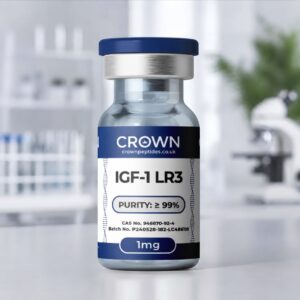
IGF-1 LR3 Research Peptide
HPLC and MS verified · batch certificate published · dispatched from the UK before 2pm
Summary of Published Research
This table highlights an important nuance: genuine clinical evidence exists for IGF-1 (unmodified) in specific, narrow medical contexts, but IGF-1 LR3 specifically — the modified, long-acting research version — has a considerably thinner independent human evidence base of its own.
The Original Rat Studies That Established LR3’s Potency Advantage
It’s worth examining the foundational research that first quantified IGF-1 LR3’s potency advantage over native IGF-1, since these studies remain the most frequently cited basis for the compound’s characterisation. Early comparative binding-assay research found that IGF-1 LR3’s modifications substantially reduced its affinity for IGFBP-1 through IGFBP-6 relative to native IGF-1, while its affinity for the IGF-1 receptor itself remained comparable — meaning the modification selectively disrupted binding-protein interaction without meaningfully compromising the receptor-binding activity researchers actually wanted to study. This selective disruption is precisely what gives IGF-1 LR3 its research value: a molecule that retains full receptor-activating capacity while evading the buffering system that normally limits how much of that capacity reaches target tissue at any given time.
Potential Research Applications
Based on the published literature, researchers have investigated IGF-1 LR3 as a tool for studying:
- IGF-1 receptor signalling pathways (PI3K/Akt, MAPK/ERK) in isolation from endogenous IGF-1 regulation
- Skeletal muscle satellite cell biology and hypertrophy/hyperplasia mechanisms
- Myostatin antagonism and its relevance to muscle-wasting disease research
- Comparative research on IGFBP-mediated regulation of IGF-1 bioavailability
As with the other compounds in this series, this is research investigating mechanisms, not evidence of an established treatment effect. Given the genuine safety considerations discussed below, this distinction carries particular weight for IGF-1 LR3.
Why the Mitogenic Safety Consideration Deserves Particular Care
It’s worth being direct and specific about a safety consideration that applies with particular force to this compound. IGF-1 signalling is fundamentally a growth and proliferation pathway — it’s the same signalling axis implicated in normal tissue growth during development, and IGF-1 receptor signalling has also been extensively studied in cancer biology, given its role in promoting cell proliferation and survival. Because IGF-1 LR3 specifically bypasses the IGFBP regulatory system that normally limits free IGF-1 exposure, and because it has been documented to be several times more potent than native IGF-1 in binding assays, this theoretical mitogenic safety consideration applies to IGF-1 LR3 with particular force compared to native IGF-1 itself. This isn’t a hypothetical caveat included for completeness — it’s a direct consequence of the specific modification that gives this compound its research-relevant extended bioavailability in the first place.
Current Limitations and Safety Considerations
- Bypasses normal IGF-1 regulatory feedback by design. IGF-1 LR3’s specific engineering to resist IGFBP binding is what gives it research value, but it’s also what removes a layer of the body’s normal regulatory control over IGF-1 activity — a genuinely different risk consideration from GHRH-axis peptides that work through the intact feedback system.
- Effects on glucose metabolism and insulin sensitivity. Because IGF-1 LR3 interacts with the insulin receptor to some degree, glucose and insulin sensitivity effects are a recognised safety consideration requiring careful monitoring in any research protocol.
- Theoretical concerns about cell proliferation signalling. Because IGF-1 receptor activation drives cell proliferation pathways, and because IGF-1 signalling has been studied in relation to cancer cell growth in the broader oncology literature, this is a relevant safety consideration for any extended research protocol, similar in kind to concerns raised for other angiogenesis- and proliferation-promoting compounds discussed elsewhere in this series.
- Limited IGF-1 LR3-specific human safety data. Much of the safety reasoning applied to IGF-1 LR3 extrapolates from native IGF-1 and general IGF-1 receptor biology rather than from dedicated human trials of the LR3-modified compound itself.
- No FDA approval for IGF-1 LR3. The related unmodified IGF-1 molecule (Increlex) is approved for a narrow rare-disease indication; IGF-1 LR3 itself holds no such approval and is sold exclusively as a research compound.
Side Effects Reported in Research
Because IGF-1 LR3 bypasses normal IGFBP-mediated regulation, its safety considerations are meaningfully different from peptides that work through the intact GH/IGF-1 feedback loop. Effects on glucose metabolism and insulin sensitivity are a recognised and specific concern requiring careful monitoring, given the molecule’s cross-reactivity with the insulin receptor.
Given the genuine theoretical concern around sustained, unregulated IGF-1 receptor activation and cell proliferation signalling, and the limited IGF-1 LR3-specific human safety data available, any research protocol involving human or animal subjects should be developed with particularly careful ethical and institutional review, following standard safety monitoring practices for investigational compounds.
Dosing Used in Published Research
This section is included for methodological context only and should not be interpreted as guidance for use.
Published research on IGF-1 and its analogues in specific medical contexts (such as HIV-associated wasting or severe IGF-1 deficiency) has used clinically supervised, condition-specific dosing protocols. Given how limited IGF-1 LR3-specific human trial data is, and the genuine safety considerations around bypassing IGF-1’s normal regulatory feedback, published dosing figures for related but distinct forms of IGF-1 should not be extrapolated to IGF-1 LR3 research protocols without independent verification against the primary literature for this specific compound.
Researchers designing their own experimental protocols should base dosing decisions on the primary literature relevant to their specific model, in consultation with institutional ethics review as applicable, rather than on secondary summaries such as this one.
Related Compounds and Research Directions
IGF-1 LR3 differs mechanistically from the GHRH-axis peptides discussed elsewhere in this series (tesamorelin, sermorelin, CJC-1295) in that it acts downstream, directly at the IGF-1 receptor, rather than stimulating the body’s own regulated GH/IGF-1 production. Comparative research clarifying the relative safety and research utility of upstream (GHRH-based) versus direct (IGF-1 LR3) approaches to studying this axis remains a valuable area of ongoing interest.
Frequently Asked Questions
Does IGF-1 LR3 Need to Be Refrigerated?
Yes, IGF-1 LR3 requires refrigeration both before and after reconstitution to preserve its delicate structure and biological activity. Unopened vials should be kept in a refrigerator or freezer, while reconstituted solutions must always be stored in the fridge and never frozen.
Preparing IGF-1 LR3 for Laboratory Work
Preparing IGF-1 LR3 for laboratory work follows standard practice for lyophilised peptides: work on a clean surface, use a sterile research diluent selected under your own protocol, and let the powder dissolve fully with gentle swirling before use. Once prepared, the solution should be stored as described in the storage section of this guide.
Choosing a Diluent Volume for IGF-1 LR3
The diluent volume is set by the researcher’s own protocol. More diluent gives a lower concentration and larger, easier-to-measure transfer volumes; less diluent gives a higher concentration. For example, 2 mL added to a 10 mg vial gives 5 mg/mL. Our concentration calculator works out the figures for any volume.
How to Store IGF-1 LR3?
Unopened lyophilized IGF-1 LR3 powder should be stored in a freezer or refrigerator away from direct light for long-term preservation. Once reconstituted with bacteriostatic water, it must be kept in the refrigerator and used within a few weeks for optimal potency.
Is IGF-1 LR3 a Peptide?
Yes, IGF-1 LR3 (Insulin-like Growth Factor-1 Long R3) is a synthetic protein and peptide analogue composed of 83 amino acids. It is an extended version of naturally occurring human IGF-1, modified to resist binding to carrier proteins and significantly extend its half-life.
Why Peptide Sourcing Quality Matters for Research Validity
As an 83-amino-acid protein with specific structural modifications essential to its function, IGF-1 LR3 is particularly sensitive to synthesis errors that could affect either its core receptor-binding activity or the specific modifications that give it its extended half-life.
- Truncated or deletion sequences — incomplete coupling during synthesis of this relatively long protein can leave a proportion of the product missing residues critical to receptor binding or IGFBP resistance.
- Inaccurate mass or concentration labelling — without independent mass spectrometry confirmation, there’s no reliable way to verify that a vial contains the peptide and concentration stated on the label, which matters particularly given the safety considerations already discussed.
- Bacterial endotoxin contamination — relevant for any in vivo or cell-culture research involving proliferation and metabolic endpoints.
Given the genuine safety considerations already inherent to this compound’s mechanism, independent verification of identity, purity, and concentration is a particularly important precondition for responsible research use.
Read the certificate before you order
Every batch is published openly — identity by mass spectrometry, purity by HPLC, and the batch number printed on the vial you receive.
Open the COA libraryWhy Choose Crown Peptides
Testing is only part of the picture. Crown Peptides was built around a simple idea: a UK researcher ordering a peptide should be able to trust everything about how it reached them — not just the number on a Certificate of Analysis, but who made it, how it was handled, how it travelled, and who they can speak to if they have a question. That’s the standard we hold ourselves to on every order, and it’s worth explaining properly rather than just listing it.
Sourcing You Can Trust
Quality starts long before a product reaches our warehouse. We work directly with one of the world’s largest and most established peptide synthesis manufacturers, chosen specifically for its production standards, consistency, and track record — rather than sourcing opportunistically from whichever manufacturer happens to offer the lowest price that month. That close, ongoing partnership is what allows us to stand behind every batch we sell, because we know exactly how it was made.
Verified Through Independent Testing
We don’t expect researchers to take a manufacturer’s word for it, so we verify every batch independently before it’s listed for sale:
Endotoxin Testing
Every batch is screened for bacterial endotoxin, which matters in particular for any research involving cell culture, immune signalling, or in vivo inflammatory endpoints.
HPLC Purity Analysis
High-performance liquid chromatography is used to assess purity and screen for truncated sequences, deletion products, and synthesis by-products.
Mass Spectrometry Identity Confirmation
MS analysis confirms the molecular weight of the supplied peptide matches intact IGF-1 LR3, providing an independent check on identity and completeness beyond the label.
Certificate of Analysis
Every batch is supplied with a Certificate of Analysis, and a QR code linking directly to the testing report on crownpeptides.co.uk, so researchers can document exactly what was used in their own experimental records.
Careful Storage and Handling
A product that’s been correctly synthesised and tested can still be let down by poor handling afterward. Once a batch clears testing, we store it under controlled conditions designed to preserve stability and prevent degradation before it ever reaches a researcher’s bench. This matters more for peptides and sensitive research compounds than for most laboratory reagents: temperature excursions, light exposure, and poor stock rotation can all silently reduce integrity long before a vial is opened, in ways that aren’t visible on inspection and can quietly undermine an experiment’s results. We treat that storage window as part of the product, not an afterthought once testing is done.
Packaging and Delivery
Every order is packed in premium, discreet packaging designed to protect the product in transit and arrive intact. Orders placed before 2pm are dispatched the same working day for next-day UK delivery, and we ship to Northern Ireland, the Republic of Ireland, Scotland, England, and across the EU, with international shipping available beyond that. For a researcher working to a study timeline, knowing an order will arrive quickly, safely, and exactly as ordered isn’t a convenience — it’s part of keeping a research schedule on track.
Support That Goes Beyond the Sale
Peptide and research-compound work raises genuine practical questions — around reconstitution, storage, handling, and interpreting a Certificate of Analysis — and we’d rather a researcher ask us directly than guess. Our team is on hand to provide clear, straightforward guidance from product selection through to delivery and beyond, without the evasiveness or upsell pressure that can come with some suppliers in this space. We see that ongoing relationship, not just the transaction, as the actual job.
Regulatory Compliance and Transparency
Crown Peptides is a UK-based company operating in line with MHRA guidance on research chemicals. Every product is clearly labelled for laboratory research use only, sold on the basis that the purchaser is a qualified professional legally able to handle these materials, and never marketed, described, or sold as suitable for human consumption, therapeutic use, or diagnostic application. We’d rather be transparent about what we sell and who it’s for than blur that line to chase a wider customer base — that’s a deliberate choice on our part, not a legal minimum we begrudgingly meet.
Our Commitment
Put simply, our mission is to supply the UK research community with peptides and research compounds of unmatched purity and consistency, backed by a level of service, transparency, and technical support that researchers can actually rely on — from the first email enquiry to the vial arriving on the bench. That standard applies whether an order is a single vial for an independent researcher or a bulk order for a laboratory, and it holds regardless of whether a customer ever finds out how much work sits behind it.
Crown Peptides’ products are supplied strictly for laboratory research and are not sold, labelled, or intended for human consumption, diagnosis, treatment, or prevention of disease. For researchers who want their results to be reproducible and their experimental record defensible, knowing precisely what’s in the vial — and trusting that everyone who handled it got it right — is a basic, non-negotiable starting point.
IGF-1 LR3 sits within our wider research peptides UK catalogue, with a published certificate for every batch.
References
- “IGF-1 LR3.” PubChem, National Center for Biotechnology Information. https://pubchem.ncbi.nlm.nih.gov/compound/IGF-1-LR3
- “Myostatin suppresses both basal and IGF-1-stimulated proliferation of preadipocytes and muscle satellite cells.” Representative myostatin/IGF-1 literature. https://pubmed.ncbi.nlm.nih.gov/
- FDA. Increlex (mecasermin) Prescribing Information. https://www.accessdata.fda.gov/drugsatfda_docs/label/
Working with IGF-1 LR3 Research Peptide
Batch-tested material, published certificates, and same-day dispatch on orders placed before 2pm.
See IGF-1 LR3 Research Peptide