

Peptide testing in the UK helps verify whether a product contains the correct peptide, meets its claimed purity level, and has been assessed for relevant contaminants. Reliable suppliers should provide batch-specific laboratory evidence rather than relying on generic purity claims.
However, testing does not automatically prove that a peptide is medically approved, safe for human use, or legally supplied as a medicine. UK medicinal products remain subject to MHRA requirements. Analytical testing also relates only to the specific sample submitted for analysis and should not be interpreted as evidence that every batch sold by a supplier has been independently tested unless batch-specific documentation is available.
The short version
- HPLC tells you how much of the vial is the peptide. Mass spectrometry tells you whether it is the right one.
- Both are needed — either alone leaves a gap a supplier can hide in.
- A certificate should name the batch, the method and the result, not just a percentage.
- Deletion sequences missing a single residue are the hardest impurity to catch without a chromatogram.
Common Peptide Testing Methods
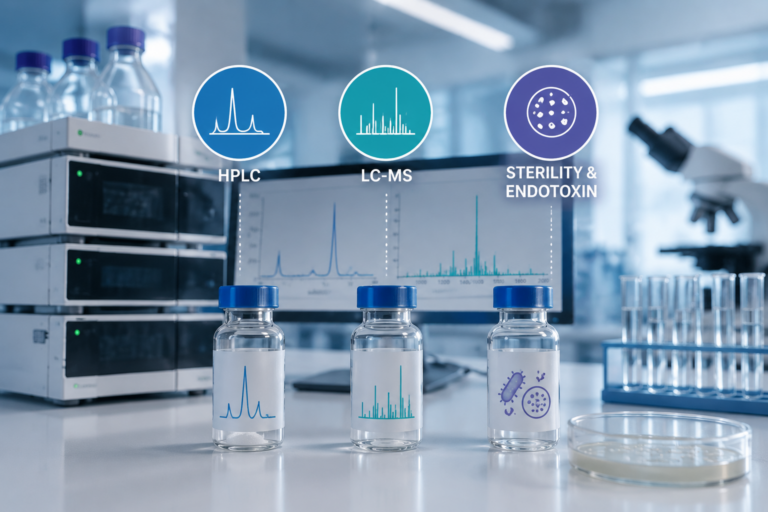
Different analytical methods answer different questions. HPLC commonly evaluates purity, while LC-MS helps confirm molecular identity. Products represented as sterile may also undergo sterility and endotoxin testing where appropriate. A strong testing package normally combines complementary methods because no single test provides a complete assessment of quality.
HPLC Peptide Purity Testing
High-performance liquid chromatography (HPLC) separates the peptide from detectable impurities and degradation products. The resulting chromatogram displays a series of peaks, with the principal peptide usually represented by the largest peak.
The reported HPLC purity percentage is method-dependent and reflects the chromatographic profile under the specific analytical conditions used. Results obtained using different methods or laboratories may not be directly comparable and should be supported by the full chromatogram, analytical conditions and testing details rather than presented as an isolated number.
LC-MS Peptide Identity Testing
Liquid chromatography–mass spectrometry (LC-MS) separates sample components and measures their mass-to-charge ratios. The observed molecular mass is then compared with the peptide’s expected theoretical molecular mass.
A matching result provides strong evidence supporting the peptide’s identity but should always be interpreted alongside chromatographic data because purity and identity are separate quality measurements. Molecular mass alone may not distinguish every closely related impurity, structural isomer or sequence variant.
Endotoxin & Sterility Testing
Endotoxin testing detects toxins associated with certain Gram-negative bacteria, while sterility testing assesses whether viable microorganisms are present under specified test conditions. These are different tests and are not interchangeable.
They are particularly relevant where a product is represented as sterile, but passing either test does not independently demonstrate that a peptide is authorised, medically approved or suitable for human administration.
How Does Peptide Testing Work in the UK?
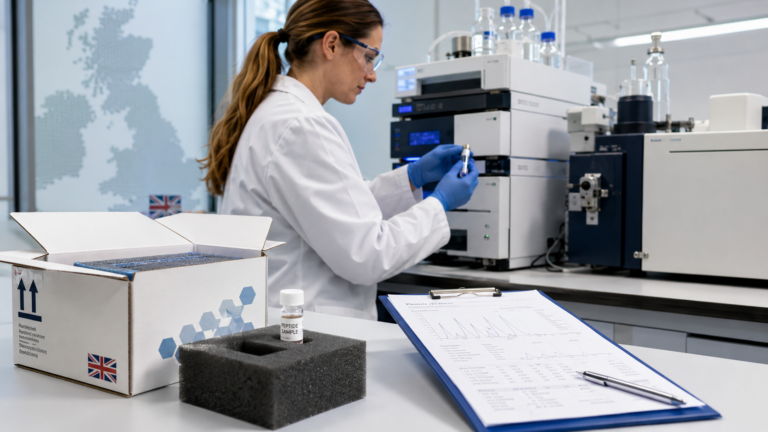
The exact procedure varies depending on the laboratory, the peptide being analysed and the scope of testing requested. In general, the customer selects a suitable laboratory, submits a labelled sample, agrees the required analytical methods and receives a formal report containing the results.
Step 1: Choose a Testing Laboratory
Select a laboratory with demonstrable experience in peptide analysis and the analytical methods required, such as HPLC, LC-MS or microbiological testing.
Where appropriate, check whether the laboratory holds UKAS accreditation to ISO/IEC 17025 for the specific testing activity. Accreditation should always be verified against the laboratory’s current scope, as it may not apply to every analytical service offered.
Step 2: Submit Your Peptide Sample
The laboratory will normally provide instructions covering sample quantity, packaging, storage and shipping conditions.
Label the sample with a unique batch or lot number and keep a clear record of its origin. Correct handling is important because exposure to unsuitable temperatures, moisture or poor storage conditions may alter the sample before analysis.
Step 3: Laboratory Analysis
The laboratory prepares the sample and performs the agreed analytical methods.
HPLC may be used to assess the chromatographic purity profile, while LC-MS compares the detected molecular mass with the expected theoretical molecular mass. Additional testing may include sterility, endotoxins, water content or other contaminant analysis where appropriate.
Results should always be assessed against pre-agreed specifications using validated or otherwise suitable analytical methods.
Step 4: Receive Your Certificate of Analysis
Following analysis, the laboratory will normally issue a Certificate of Analysis (CoA) or analytical report.
The report should identify the sample, batch number, analytical methods, specifications, results, testing date and issuing laboratory.
Confirm that each result relates to the actual submitted batch. A professionally presented certificate alone does not verify that the reported results relate to the product being supplied. The issuing laboratory, batch details and analytical report should all be independently verifiable.
How to Read a Peptide Certificate of Analysis (CoA)
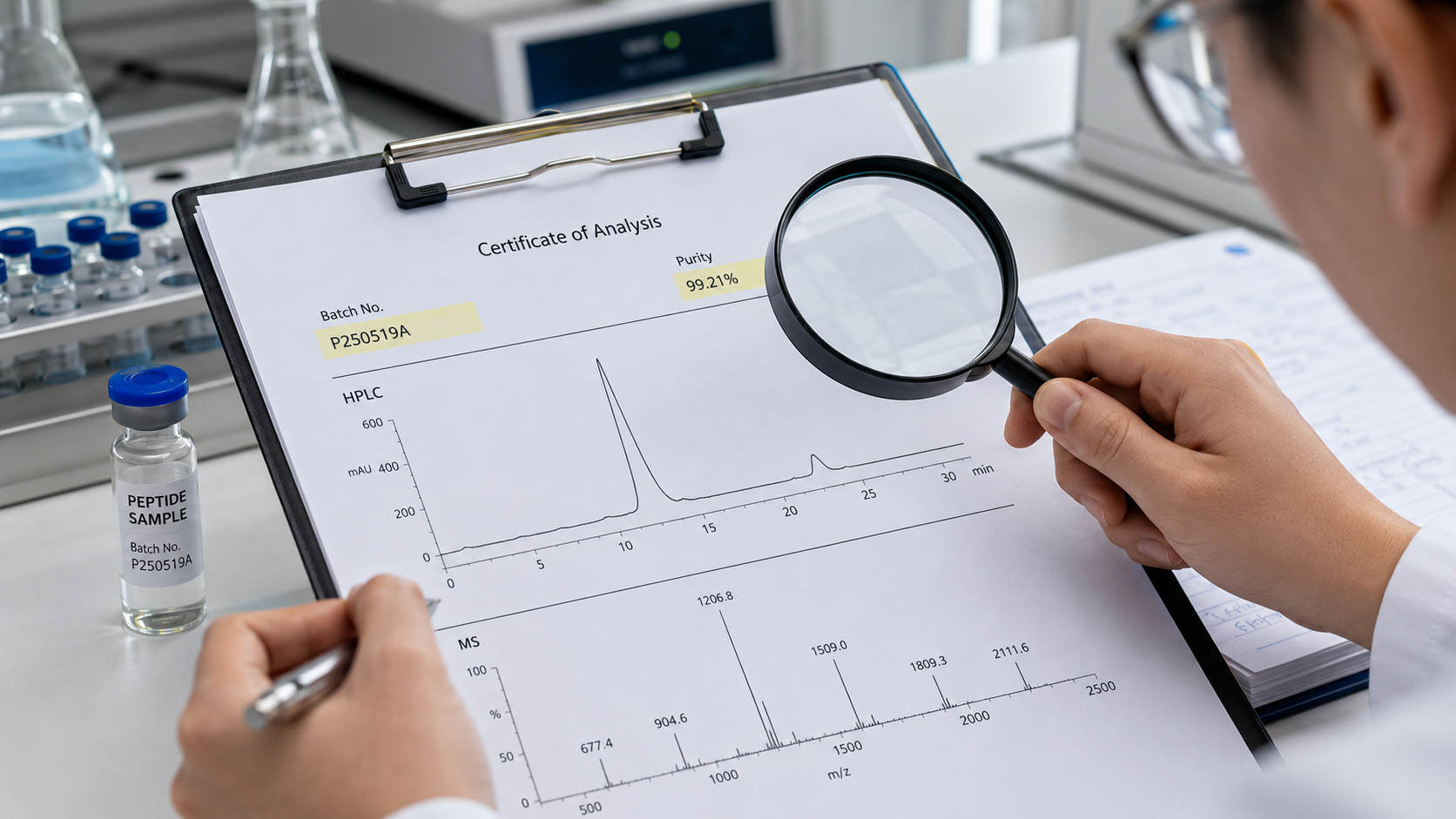
A peptide CoA should allow you to link the tested sample to the product being supplied and understand how each conclusion was reached.
Do not judge a CoA solely by its appearance or by the presence of a high purity figure. Instead, review the underlying analytical evidence together with the laboratory information.
Batch Number
The batch or lot number links the laboratory result to a specific production run.
It should match the number shown on the peptide vial, packaging or supplier records. A CoA without a batch number—or one reused across multiple unrelated products—cannot reliably demonstrate that your particular product was tested.
Also check the sample description, testing date and laboratory reference number.
Purity %
The purity percentage generally represents the relative chromatographic area of the principal peak under the stated HPLC method.
It does not necessarily represent the peptide’s total weight, concentration or biological activity.
Look for the analytical method, chromatographic conditions, detection wavelength, integration details and the complete chromatogram. A simple statement such as “99% purity” provides very limited evidence when presented without supporting analytical data.
Purity Does Not Equal Peptide Content
A reported purity of 99% does not necessarily mean a vial contains the exact labelled quantity of peptide.
Purity describes the relative chromatographic profile of the sample under the stated analytical method, whereas content (assay) measures the actual amount of peptide present. These are different analytical measurements and should not be confused.
HPLC Chromatogram
The chromatogram visually displays the peaks detected during HPLC analysis.
Check that it includes a sample identifier, clearly labelled axes, retention times, peak table and integration results. The principal peak should correspond with the reported purity calculation.
Cropped, low-resolution or unlabelled chromatograms are difficult to authenticate and may conceal secondary peaks or incomplete analytical information.
Mass Spectrum
The mass spectrum displays the detected mass-to-charge signals together with the calculated or deconvoluted molecular mass.
Compare the observed molecular mass with the expected theoretical molecular mass and review any stated tolerance.
A matching molecular mass strengthens confidence in the sample’s identity, although molecular mass alone may not distinguish every sequence variant, structural isomer or closely related impurity.
Signs a Peptide Supplier May Not Be Reliable
❌ No Batch-Specific CoA
A generic Certificate of Analysis cannot demonstrate that the vial being sold originated from the tested batch.
Reliable documentation should include a batch number that matches the product packaging, together with the testing date and sample identification.
❌ Only Shows a Purity Percentage Without Chromatograms
A statement such as “99% pure” is easy to publish but difficult to verify without the supporting chromatogram, peak table and analytical method.
Ask to see the underlying evidence used to calculate the reported purity.
❌ No Identity Testing
HPLC purity alone does not necessarily confirm that the principal chromatographic peak is the peptide named on the label.
Reliable analytical packages normally include an appropriate identity test, commonly LC-MS, alongside purity testing.
ICH analytical validation guidance recognises that identification based solely on chromatographic retention time is generally not considered sufficiently specific for definitive identification.
❌ Refuses Independent Testing
A supplier that discourages independent laboratory analysis, refuses to provide sufficient batch information or challenges customers for verifying results may be avoiding appropriate scrutiny.
Independent testing can help determine whether the supplier’s documentation accurately reflects the product supplied.
❌ Makes Exaggerated Medical Claims
Be cautious of suppliers promising guaranteed fat loss, muscle gain, anti-ageing effects or treatment of medical conditions without appropriate authorisation and supporting clinical evidence.
A laboratory report does not transform an unauthorised peptide into an approved medicine. The MHRA has taken enforcement action against the suspected illegal manufacture, supply and promotion of unlicensed peptide and weight-management products within the UK.
Looking for tested research peptides?
Batch-tested material, certificates published openly, and same-day dispatch on orders placed before 2pm.
Browse research peptidesRead the certificate before you order
Every batch is published openly — identity by mass spectrometry, purity by HPLC, and the batch number printed on the vial you receive.
Open the COA libraryResearch peptides from Crown Peptides
Every compound HPLC and MS verified, batch certificates published in full, dispatched from the UK before 2pm.
