

Peptide reconstitution is the process of adding an appropriate diluent to a lyophilised (freeze-dried) peptide before it can be used. The correct diluent, preparation method, mixing volume and storage conditions vary between products and should always follow the manufacturer’s instructions or advice from a qualified healthcare professional.
This guide explains the general principles of peptide reconstitution and highlights common preparation mistakes. It is not intended to replace the official product instructions, patient information leaflet or advice from a healthcare professional.
Medical Disclaimer: This article is provided for general educational purposes only and does not constitute medical advice, dosing instructions or injection training. Incorrect preparation may result in contamination, infection, dosing errors or product degradation. Only reconstitute a legally supplied medicine when instructed by a qualified healthcare professional.
The short version
- Bacteriostatic water contains 0.9% benzyl alcohol, which is what allows repeated withdrawal.
- Add the solvent down the vial wall, never directly onto the powder.
- Swirl, do not shake — agitation can denature the peptide.
- Reconstituted peptide has a far shorter working life than the lyophilised powder.
How Peptide Reconstitution Works
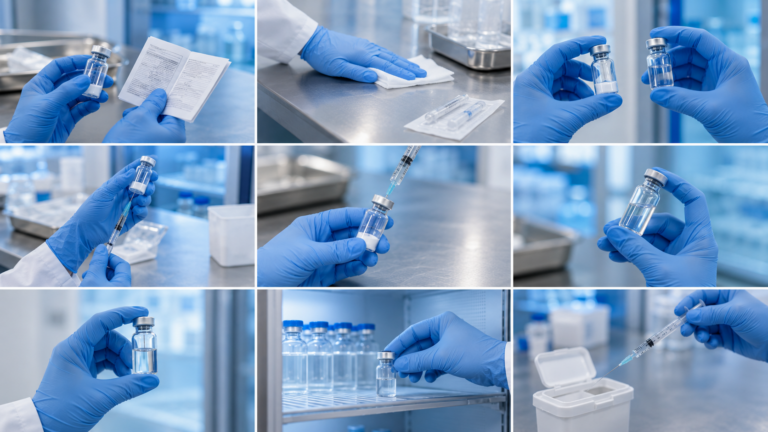
The following information outlines general safety principles rather than instructions for preparing any specific peptide. Preparation requirements vary significantly between products, and the manufacturer’s instructions should always take priority.
Step 1: Check the Product Instructions
Read the product label and patient information leaflet before opening the vial.
Confirm the product name, vial strength, expiry date, required diluent, liquid volume and storage instructions. Never assume that preparation instructions for one peptide apply to another.
If the required diluent or preparation method is unclear, stop and seek advice from a pharmacist or qualified healthcare professional.
Step 2: Prepare a Clean Working Area
Wash and dry your hands thoroughly before handling the product.
Clean and disinfect the preparation surface before assembling the vial, appropriate diluent and any equipment specified in the product instructions.
Avoid touching needles, syringe tips, vial openings or cleaned rubber stoppers, as contact with fingers or unclean surfaces may introduce microorganisms into the preparation.
Step 3: Inspect the Vial and Diluent
Check that both the peptide vial and diluent are correctly labelled, unopened and within their expiry dates.
Do not use a vial with a damaged seal, leakage, unusual discolouration or visible contamination.
Confirm that the liquid is the exact diluent specified in the official instructions. Sterile water, bacteriostatic water and saline are different products and should not be treated as interchangeable unless specifically instructed.
Step 4: Measure the Required Diluent
Measure only the volume specified on the product label or provided by a qualified healthcare professional.
Adding too much liquid reduces the final concentration, while adding too little increases it.
Never estimate the required volume based on vial size or information intended for another product, even if the products appear similar.
Step 5: Add the Diluent Carefully
Transfer the approved diluent using the method described in the manufacturer’s instructions or demonstrated by a qualified healthcare professional.
Some products recommend directing the diluent slowly against the inside wall of the vial to minimise foaming.
Do not forcefully spray the liquid directly onto the powder unless the official preparation instructions specifically recommend doing so.
Step 6: Mix as Directed
Use the exact mixing technique described in the product instructions.
Many peptide products recommend gentle swirling, rolling or controlled inversion rather than vigorous shaking.
Excessive agitation may create foam or affect the stability of certain peptide formulations. However, preparation methods differ between products, so never assume that one mixing technique applies universally.
Step 7: Inspect the Solution
Examine the reconstituted solution in good lighting and compare it with the appearance described in the official product information.
Do not use the product if it is unexpectedly cloudy, discoloured, contains visible particles or has failed to dissolve as expected.
The acceptable appearance is product-specific, so online photographs should never be used as the sole reference.
Step 8: Store or Use as Directed
Follow the manufacturer’s instructions for storage temperature, protection from light and permitted in-use storage period.
Some preparations require immediate use, while others may be stored under refrigeration for a limited time.
Never create your own expiry period or assume that using bacteriostatic water extends the usable life of every product.
Step 9: Dispose of Equipment Safely
Place used needles and syringes directly into an approved sharps container immediately after use.
Never reuse or share injection equipment.
Dispose of expired or unused medicines in accordance with advice from a pharmacist or local healthcare service. Loose needles should never be placed into household rubbish or recycling.
Calculating Peptide Concentration
The basic concentration formula is:
Vial Amount ÷ Volume of Diluent Added = Concentration per mL
For example:
10 mg ÷ 2 mL = 5 mg/mL
This formula only calculates the concentration of the prepared solution. It does not determine an appropriate dose, injection volume or treatment schedule.
Ensure that the vial amount and liquid volume use compatible units. Avoid relying on universal dosing charts, injection-unit conversions or generic online calculators unless specifically provided for the product by an appropriately qualified healthcare professional.
Common Peptide Reconstitution Mistakes
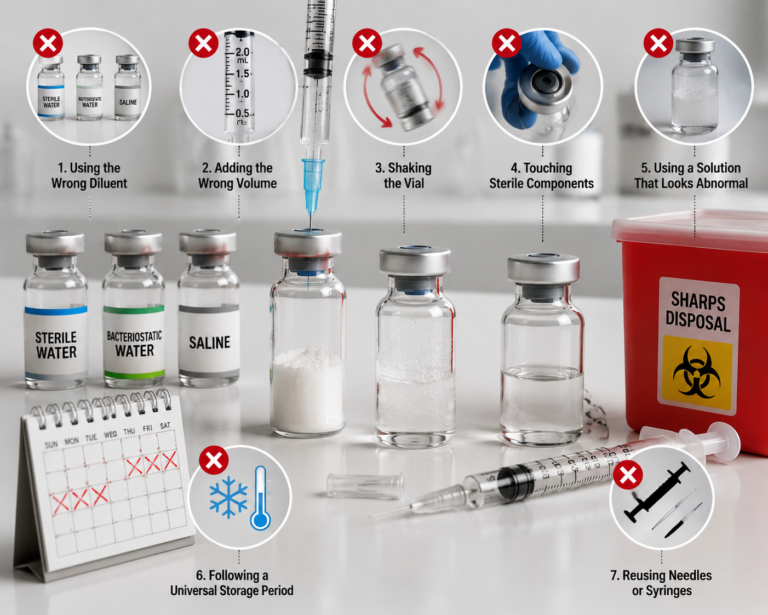
Small preparation errors may alter the final concentration, introduce contamination or reduce the stability of a peptide.
Every product should be treated individually, and professional advice should be sought whenever the preparation instructions are unclear.
1. Using the Wrong Diluent
Sterile water, bacteriostatic water and saline are not interchangeable.
Some peptide products require a manufacturer-supplied solvent or another specific diluent. Using an unsuitable liquid may affect compatibility, stability or product quality.
Always verify the required diluent using the manufacturer’s instructions or advice from a pharmacist.
2. Adding the Wrong Volume
Using the wrong volume changes the final concentration and may result in significant measurement errors.
Always check both the vial strength and required mixing volume before preparation.
Never estimate the required volume based on vial size or reuse calculations from another peptide.
3. Shaking the Vial
Vigorous shaking may create foam and may affect the stability of certain peptide formulations.
Many products instead recommend gentle swirling, rolling or controlled inversion.
Always follow the mixing method described for the specific product rather than assuming the same technique applies to every peptide.
4. Touching Sterile Components
Touching needles, syringe tips, vial openings or cleaned stoppers may introduce microorganisms into the preparation.
Once sterility has been compromised, it cannot simply be restored by wiping the component again.
Use an aseptic non-touch technique and replace any equipment that may have contacted fingers, clothing or unclean surfaces.
5. Using a Solution That Looks Abnormal
Do not use a product that is unexpectedly cloudy, discoloured, contains visible particles or has failed to dissolve as described.
Reconstituted peptide products do not all have the same appearance.
Compare the solution with the manufacturer’s description and seek advice from a pharmacist rather than attempting to correct an abnormal solution.
6. Following a Universal Storage Period
There is no universal storage period for every reconstituted peptide.
Some products require immediate use, while others permit limited refrigerated storage.
Always follow the manufacturer’s stated in-use expiry rather than applying a general 7-day, 14-day or 28-day rule.
7. Reusing Needles or Syringes
Needles and syringes should never be shared and should not be reused unless specifically designed and approved for repeated use.
Reuse increases the risk of contamination, infection, injury and inaccurate measurement.
Dispose of disposable equipment immediately after use in an approved sharps container.
Frequently Asked Questions
Can All Peptides Be Mixed With Bacteriostatic Water?
No. Bacteriostatic water is not a universal diluent. Always use only the diluent specified by the manufacturer or recommended by a qualified healthcare professional.
How Much Liquid Should Be Added?
Only the exact volume stated in the manufacturer’s instructions or prescribed by a qualified healthcare professional should be used.
There is no universal mixing volume for peptides.
Why Should Peptides Not Be Shaken?
Vigorous shaking may create foam or affect the stability of certain peptide formulations.
Always use the mixing technique specified in the official product instructions.
What Should a Reconstituted Peptide Look Like?
The solution should match the appearance described in the manufacturer’s product information.
Do not use the product if it is unexpectedly cloudy, discoloured or contains visible particles.
How Long Does a Reconstituted Peptide Remain Usable?
The permitted in-use shelf life varies between products.
Always follow the manufacturer’s storage instructions and stated expiry after reconstitution rather than applying a general timeframe.
Can Sterile Water and Bacteriostatic Water Be Used Interchangeably?
Not automatically.
Their ingredients, intended uses and compatibility differ between products, so substitution should only occur where the manufacturer specifically permits it or a qualified healthcare professional advises it.
Can Different Peptides Be Mixed Together?
Not unless the manufacturer or a qualified healthcare professional specifically recommends it.
Different peptides may have different compatibility, stability and storage requirements. Mixing products without supporting evidence may affect their quality or stability.
Looking for tested research peptides?
Batch-tested material, certificates published openly, and same-day dispatch on orders placed before 2pm.
Browse research peptidesRead the certificate before you order
Every batch is published openly — identity by mass spectrometry, purity by HPLC, and the batch number printed on the vial you receive.
Open the COA libraryResearch peptides from Crown Peptides
Every compound HPLC and MS verified, batch certificates published in full, dispatched from the UK before 2pm.
