Register today and get 10% off your first orderRegister for 10% off your first orderRegister now
Crown Peptides
SAVE20%

Research Peptides

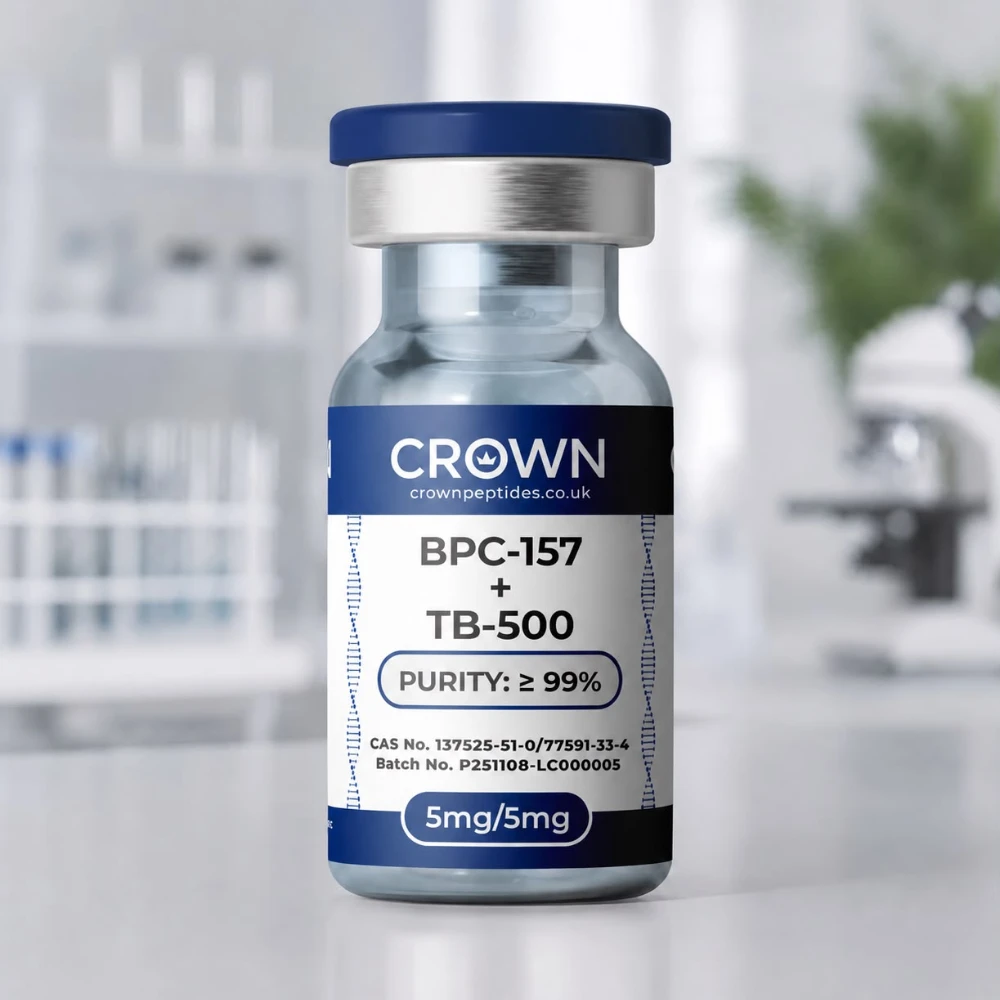
BPC-157 + TB-500 Blend (Wolverine Stack)

A high-purity research blend studied in tissue repair and cell-migration research. Available in 5mg/5mg and 10mg/10mg, with every batch independently tested and dispatched from the UK.

£44.99or from £35.99 per vial in packs of 10
Save up to 20%
From: £44.99
Your selection:
Batch level verified
All Batches TestedEvery batch, no exceptions
HPLC & MS VerifiedFull certificate published
Same Day PostageOrder before 2pm
UK Based CompanyDispatched from the UK
Product Overview

A high-purity research blend studied in tissue repair and cell-migration research. Available in 5mg/5mg and 10mg/10mg, with every batch independently tested and dispatched from the UK.

Full Product Specification
Overview

Product Overview

Wolverine Blend peptide UK is Crown Peptides' multi-peptide research blend combining BPC-157 and TB-500, available in 5mg+5mg and 10mg+10mg strengths for laboratory research.

5mg+5mg & 10mg+10mgAvailable strengthsHPLC testedChromatographic purityMS verifiedIdentity confirmedBatch CoADocumentation supplied

Supplied for laboratory research purposes only — not for human consumption or for medical, veterinary or diagnostic use.

Key features

Key Features

  • Studied in research involving BPC-157-associated tissue-response research
  • Studied in research involving thymosin beta-4/TB-500-related actin biology
  • Studied in research involving cell migration and angiogenesis
  • Studied in research involving wound-healing and connective-tissue models
  • Batch-specific quality documentation available
Background

About Wolverine Blend Peptide UK

The Wolverine Blend combines two research peptides frequently studied in tissue-response models. BPC-157 is a 15-amino-acid peptide investigated across wound-healing, gastrointestinal and connective-tissue research, while TB-500 is associated with thymosin beta-4-related research involving actin, cell migration and angiogenesis.

Also known as: Wolverine blend, BPC 157 TB 500, BPC157 TB500, BPC/TB-500 blend.

Research

Wolverine Blend Research

The scientific rationale for studying these components together comes from their distinct but potentially overlapping research areas. BPC-157 literature includes tissue response, vascular signalling and gastrointestinal models, while thymosin beta-4/TB-500-related literature on angiogenesis and its modes of action (Learn more) focuses strongly on actin dynamics, cellular migration and wound-healing processes. Bringing the two together lets researchers study those overlapping repair pathways within a single formulation.

  • BPC-157-associated tissue-response research
  • Thymosin beta-4/TB-500-related actin biology
  • Cell migration and angiogenesis
  • Wound-healing and connective-tissue models
Full-length thymosin beta-4: what TB-500 means here

“TB-500” is one of the most loosely used names in peptide research, so it pays to be exact. In anti-doping chemistry the label usually refers to Ac-LKKTETQ, a seven-residue acetylated copy of residues 17 to 23 of thymosin beta-4, the stretch that binds actin. Many research suppliers use the same name for the whole protein instead. The TB-500 in this blend is the full 43-residue thymosin beta-4 chain, the same material as Crown Peptides’ standalone TB-500, with the formula C212H350N56O78S and a molecular weight of about 4,963.5 g/mol.

You will sometimes see thymosin beta-4 described as 44 residues. That count includes the methionine that starts the gene product; in cells this initiator methionine is removed and the new first residue, serine, is acetylated. The mature chain carries a single internal methionine at position 6, the only sulphur atom in the formula. Its first four residues also matter: prolyl oligopeptidase can release them as Ac-SDKP, a tetrapeptide studied in its own right in fibrosis research.

Equal milligrams, very different molecule counts

Both fills are a straight 1 : 1 split by weight, either 5mg of each peptide or 10mg of each. Because thymosin beta-4 is roughly three and a half times heavier than the 15-residue BPC-157, the same weight contains far fewer TB-500 molecules. A 5mg + 5mg vial holds about 3.5 micromoles of BPC-157 and about 1.0 micromole of thymosin beta-4; the 10mg + 10mg vial doubles both figures to roughly 7.0 and 2.0.

That matters when comparing papers. The one published head-to-head rat study did not use a 1 : 1 weight ratio at all; it gave the two peptides at different amounts per kilogram. A fixed-ratio blend is therefore best treated as its own test article, with results reported for the combination as supplied, rather than read across directly to work that dosed each peptide separately.

Two peptides, two mechanisms, no copper

Why pair just these two? The appeal is that they work on repair from opposite ends without obvious overlap in their direct targets. Thymosin beta-4 is the main G-actin-sequestering protein inside most cells, so its research centres on how cells reorganise their skeleton, migrate and form new vessels, and on its extracellular signalling once released. BPC-157 research, covered on its own page, concentrates on vascular and growth-factor receptor signalling in injury models.

Leaving out GHK-Cu keeps the design to two variables. GLOW and KLOW add a dominant copper peptide, which brings matrix-remodelling biology, a blue colour and metal chemistry into every experiment. For tendon, muscle or wound studies asking a narrower question about cell migration and vascular response, a copper-free pair means any effect can be traced back to just two peptides, and the powder carries no metal complex to account for. If matrix work joins the plan later, GHK-Cu can be added as a separate arm.

The first head-to-head rat study of the pair

For years the case for combining the two rested on reasoning rather than data. A study published in Joint Diseases and Related Surgery in 2026 finally tested it. Thirty-two rats had a standard Achilles tendon cut and repair and were split into four groups of eight: control, BPC-157 alone, TB-500 alone, and both together, with treatment for four weeks before biomechanical and microscopic assessment.

The results were not what the nickname might predict. The TB-500 group showed the only statistically significant gain in maximum load to failure, and the clearest improvement on the Bonar and Movin histology scores. The combined group improved on the Movin score versus controls, but adding BPC-157 to TB-500 gave no extra benefit over either peptide alone. The authors suggested the two may converge on shared downstream pathways and called for dose-optimisation and longer studies. For anyone planning combination work, that four-arm structure is the template to follow.

Specifications

Specifications

Product
Wolverine Blend (BPC-157/TB-500)
Classification
Multi-peptide research blend combining BPC-157 and TB-500
Available strengths
5mg+5mg and 10mg+10mg
Form
Research material supplied according to product label
Purity and assay
99% (HPLC), batch-specific — refer to Certificate of Analysis
Verification
HPLC and Mass Spectrometry where analytically appropriate

Compound-level reference data. Batch-specific results appear on the Certificate of Analysis.

Work out concentration with the peptide calculator
Testing

Purity and Testing

Crown Peptides Wolverine Blend is supplied for controlled laboratory research with batch-specific analytical documentation. High-Performance Liquid Chromatography (HPLC) can assess chromatographic purity, while Mass Spectrometry provides molecular information used to support identity verification.

The batch-specific Certificate of Analysis is the definitive source for the exact purity result, identity data and analytical specification of the material supplied.

Storage

Storage Conditions

  • Store unreconstituted material at -20°C ± 5°C in a cool, dry environment
  • Prepared research solutions should use validated storage conditions appropriate to the compound and study design
  • Protect from unnecessary heat, direct light and repeated temperature fluctuations
Full storage guide
Related

Related Compounds

Researchers working with the Wolverine Blend may also be interested in BPC-157, TB-500, KLOW, GHK-Cu and MOTS-c — other compounds studied in tissue repair and cellular research.

Compliance

Research Use Only

  • Laboratory research only
  • Not for human or clinical use
  • Not for human or veterinary consumption
  • Qualified personnel only
Questions

Wolverine Blend Frequently Asked Questions

About the Wolverine Stack6 questions
What exactly is in a Wolverine Stack vial?

Two peptides in equal weights: BPC-157, the 15-residue gastric-derived peptide, and TB-500, here the full 43-residue thymosin beta-4. Vials come as 5mg + 5mg or 10mg + 10mg. Because it is a mixture, the blend has no CAS number or formula of its own; each component keeps its own. You may also see it listed as BPC 157 TB 500, BPC157 TB500 or the BPC/TB-500 blend.

Where does the name Wolverine Stack come from?

It is an informal nickname borrowed from the Marvel comic character known for healing almost instantly, and it grew up in online research and enthusiast communities rather than in scientific papers. “Stack” is slang for compounds combined in one protocol. The label is loose enough that a recent analysis of clinical notes called BPC-157 on its own the “Wolverine peptide”, which is why we spell out both components on the label.

Is the TB-500 here the 43-residue protein or the short LKKTETQ fragment?

It is the full-length protein. The seven-residue fragment Ac-LKKTETQ, which anti-doping papers often call TB-500, has a molecular weight under 900 g/mol, whereas the thymosin beta-4 in this blend weighs about 4,963.5 g/mol. That difference is large enough to show immediately in mass spectrometry, so the identity data on the Certificate of Analysis settle which form is present.

Is the Wolverine Stack simply GLOW without the copper peptide?

On ingredients alone, that is a fair description. GLOW pairs the same two peptides, at 10mg apiece, with 50mg of GHK-Cu, so the copper peptide makes up most of the vial and steers the research towards matrix remodelling. The Wolverine Stack drops it entirely, and its 10mg + 10mg fill matches GLOW’s two repair peptides weight for weight, which makes the pair a natural comparison arm in a study that also uses GLOW.

What does each half of the blend bring to a repair model?

Thymosin beta-4 brings actin biology: it holds actin monomers in reserve inside cells, and its literature follows cell migration, new vessel growth and, when released outside cells, signalling to surrounding tissue. BPC-157 brings a separate line of vascular and growth-factor receptor work. Studying them together lets one experiment ask whether those two routes add up, overlap or interfere.

Has the combination been tested against each peptide alone?

Once, in rats. A four-group Achilles tendon repair study compared controls, BPC-157 alone, TB-500 alone and the combination over four weeks. TB-500 alone produced the clearest biomechanical and histology gains, and the pair improved one histology score over controls but showed no extra benefit beyond either single peptide. One small study cannot close the question, but it sets a useful benchmark.

Strengths & ratio3 questions
Who tends to choose the 10mg + 10mg fill over the 5mg + 5mg?

Groups running animal series or several treatment arms, where the larger fill means half as many vials to reconstitute for the same total peptide. The 5mg + 5mg fill is the economical route into cell-migration, tube-formation or explant work, where working concentrations are small. Single vials suit a pilot; the five- and ten-vial boxes lower the cost per vial and keep a run of experiments on one production lot.

How many molecules of each peptide does an equal-weight vial really hold?

Not equal numbers. Thymosin beta-4 is about three and a half times the mass of BPC-157, so a 5mg + 5mg vial contains roughly 3.5 micromoles of BPC-157 and 1.0 micromole of thymosin beta-4, a molar ratio near 3.5 : 1. Studies that report concentrations in molar units should convert each component separately.

When are separate BPC-157 and TB-500 vials the better choice?

Whenever the design needs single-peptide arms, which any properly controlled combination study does, or when the ratio itself is under investigation. The blend is ideal for the combined arm, giving the same proportions in every vial; the standalone peptides cover the comparison groups and any ratio other than one-to-one by weight.

Designing & checking a study3 questions
What control groups does a BPC-157 + TB-500 experiment need?

At minimum, four: vehicle, BPC-157 alone, TB-500 alone and the combination, ideally with matched amounts of each peptide in the single and combined arms. This two-by-two layout is the only way to tell an additive or synergistic effect from one peptide simply doing the work. Randomisation, blinded scoring and enough animals per group to detect a modest difference all matter; the first rat study used eight per group, a size better suited to spotting large effects than subtle ones.

Which readouts suit a combined tendon or wound model?

Pick measures that map on to each peptide’s strengths. Load to failure and stiffness capture mechanical recovery; histology scores such as Bonar or Movin, Sirius red birefringence and collagen I/III staining describe tissue quality; vessel counts or perfusion imaging cover blood supply; and scratch or transwell assays test cell migration in culture. Including a later time point helps, because early and late repair can favour different components.

How can one sample confirm both a 15-residue and a 43-residue peptide?

Size does most of the work. In reversed-phase HPLC the two chains have very different lengths and surface chemistry, so they elute as two well-resolved peaks. In electrospray mass spectrometry BPC-157 appears as one or two low charge states, while thymosin beta-4 spreads into a ladder of multiply charged ions, for example near m/z 1,241.9, 993.7 and 828.3 for the 4+, 5+ and 6+ ions, which deconvolute to its intact mass. Because methionine 6 is the only oxidisable residue of note, a companion signal 16 Da heavier on the thymosin side points to methionine sulphoxide, which is worth tracking since oxidised thymosin beta-4 behaves differently in actin assays.

Read the batch certificate before you order

Every batch is published openly — identity, purity and batch number, with no account needed.

View lab reports

Supplied for laboratory research purposes only — not for human consumption or for medical, veterinary or diagnostic use.

All Batches Purity Tested

Each batch undergoes internal analytical verification using chromatographic and spectrometric methods prior to lyophilisation.

• HPLC Analysis
• Mass Spectrometry Confirmation
• Batch Traceability

For Research Use Only

By purchasing this product you confirm that you are a qualified researcher and that this compound will be used exclusively for laboratory research purposes.

Not for Human Consumption

This product is not intended for diagnostic or therapeutic use.

Any human or medical use is strictly prohibited.

Store Safely at All Times

Store in a cool, dry, secure and sterile environment away from any unauthorised persons or children.

Other Research Peptides

5-Amino-1MQ research compound UK 10mg and 50mg vial - Crown Peptides
≥99% PURITY
HPLC & MS TESTED
5-Amino-1MQ Research Compound
From: £24.99

Buy Now

AHK-Cu 100mg research peptide vial – Crown Peptides UK
≥99% PURITY
HPLC & MS TESTED
AHK-Cu Research Peptide
From: £29.99

Buy Now

AOD-9604 5mg research peptide vial - Crown Peptides
≥99% PURITY
HPLC & MS TESTED
AOD-9604 Research Peptide
From: £34.99

Buy Now

ARA-290 research peptide UK 10mg vial - Crown Peptides
≥99% PURITY
HPLC & MS TESTED
ARA-290 Research Peptide
From: £39.99

Buy Now

Further reading

SUPPORT Mon to Fri, 9am to 5pmDISPATCH Cut-off 2pmEMAIL info@crownpeptides.co.ukWHATSAPP +44 7301 802654

Disclaimer: All products are sold strictly for laboratory research purposes only. Not for human or veterinary use, consumption, therapeutic, or diagnostic application. None of our products are medicines, and none are presented as such. By purchasing, you confirm you are a qualified professional and legally permitted to handle these materials in compliance with all applicable laws and regulations. Misuse, resale for unauthorised purposes, or unlawful application is strictly prohibited. Crown Peptides UK disclaims all liability for improper use, handling, or regulatory non-compliance.

© 2026 Crown Peptides UK, a trading name of Crown Peptides Ltd (company no. 17068950), Suite Ra01, 195-197 Wood Street, London E17 3NU . All Rights Reserved.