Research Peptides
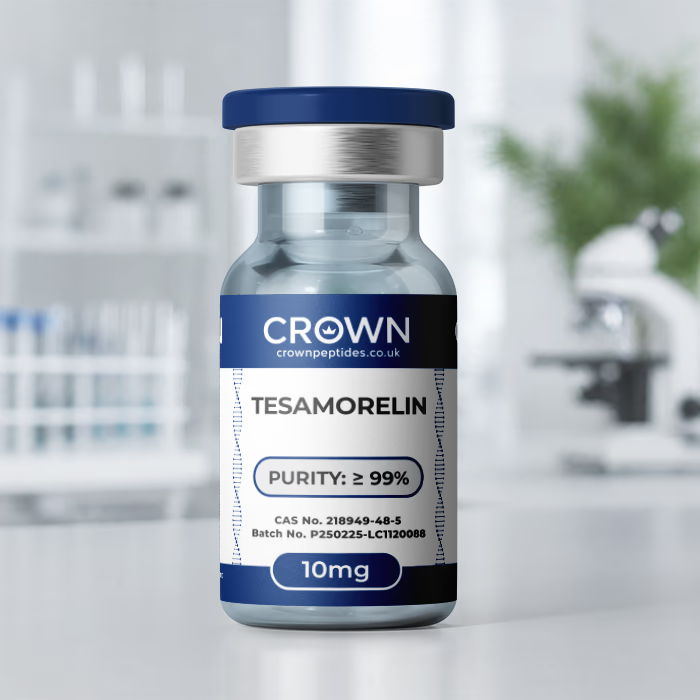
A high-purity research peptide studied in growth-hormone and fat-metabolism research. Available in 10mg and 20mg, with every batch independently tested and dispatched from the UK.
Tesamorelin peptide UK is Crown Peptides' synthetic GHRH receptor analogue, supplied in 10 mg and 20 mg vials for laboratory research. The Tesamorelin 20 mg vial carries twice the material of the 10 mg at a lower cost per milligram, which is why it is the usual choice for longer protocols or work that needs a consistent single lot across a study.
Supplied for laboratory research purposes only — not for human consumption or for medical, veterinary or diagnostic use.
Tesamorelin peptide is a synthetic analogue of growth-hormone-releasing hormone designed to activate the GHRH receptor. Its sequence is closely related to endogenous GHRH but includes a modification that improves stability against enzymatic degradation.
Also known as: Tesamorelin acetate, TH9507.
The published literature on Tesamorelin is unusually deep for a research peptide. A meta-analysis of five randomised controlled trials, published in Obesity Research & Clinical Practice in January, reported a significant reduction in visceral adipose tissue (mean difference −27.71 cm²), a reduction in trunk fat of 1.18 kg, and an increase in lean body mass of 1.42 kg, alongside raised IGF-1 — with no significant change in subcutaneous fat or BMI. A separate systematic review pooling four trials across 909 participants reached broadly the same conclusions.
Liver-focused work has drawn particular attention. A randomised placebo-controlled trial in HIV-associated NAFLD found that Tesamorelin reduced liver fat over twelve months, with fewer participants showing fibrosis progression than on placebo, and a follow-up analysis of paired liver biopsies from the same trial mapped the inflammatory and fibrotic gene-expression pathways that shifted alongside it. Cognitive endpoints have been examined too, in a Phase II trial in ageing HIV-positive adults (NCT02572323), where the between-group difference did not reach significance — a reminder that the GH–IGF-1 axis does not behave uniformly across every outcome studied.
Tesamorelin is studied in GHRH receptor pharmacology, pituitary growth-hormone release, downstream IGF-1 signalling IGF-1 LR3 and metabolic-endocrine models. Its enhanced stability compared with native GHRH makes it useful for studying sustained receptor activation (Learn more) and the consequences of altered hypothalamic-pituitary signalling.
Natural growth-hormone-releasing hormone is a 44-amino-acid peptide made in the hypothalamus, and once it reaches plasma it does not last long. Work published in the Journal of Clinical Investigation pinned most of that breakdown on dipeptidyl peptidase IV, an enzyme that cuts the bond between the second and third amino acids and leaves behind an inactive GHRH(3-44) fragment (Learn more). Tesamorelin keeps the full human 44-residue sequence and adds just one feature: a trans-3-hexenoyl group fixed to the tyrosine at the N-terminus, precisely where that enzyme attacks.
The result is a GHRH receptor agonist with the complete native chain behind it, rather than a shortened fragment or a heavily rebuilt analogue. With a reported mean elimination half-life of about 11 minutes, it suits studies of the natural rise and fall of GH release, and it sits neatly between two relatives on our shelves: Sermorelin, which uses only the first 29 residues, and CJC-1295 (with DAC), which is engineered to bind albumin and persist for days.
Tesamorelin was developed by the Montreal company Theratechnologies under the code TH9507, and on 10 November 2010 the US Food and Drug Administration approved it under the brand name Egrifta. The approved indication is deliberately narrow: reducing excess visceral abdominal fat in HIV-infected patients with lipodystrophy. Approval rested on two placebo-controlled trials involving 816 adults, with abdominal fat measured by CT scan.
Europe took a different path. Theratechnologies withdrew its application to the European Medicines Agency in June 2012, after the agency’s scientific committee questioned whether the fat reduction translated into meaningful health benefit, and raised concerns about long-term exposure to higher IGF-1 levels (Learn more). That split verdict leaves a large human dataset alongside genuinely open questions about the GH–IGF-1 axis. Crown Peptides supplies the same peptide sequence as a lyophilised research material; it is not the branded Egrifta product.
Growth hormone is released in bursts, and the timing of those bursts is largely set by somatostatin, the hypothalamic brake on the pituitary. Because a GHRH analogue works through that system rather than around it, a central question has been whether Tesamorelin amplifies the natural pattern or flattens it into a constant signal.
A two-week study of 13 healthy men by Stanley and colleagues at Massachusetts General Hospital tackled this directly, with frequent overnight blood sampling. Tesamorelin raised mean overnight GH, the average area of GH peaks and basal GH secretion, and IGF-1 rose substantially, while insulin-stimulated glucose uptake measured by clamp showed no significant change. Because IGF-1 then feeds back on both hypothalamus and pituitary, Tesamorelin models let researchers follow the whole loop, which is why it often appears alongside downstream tools such as IGF-1 LR3. Ghrelin-receptor compounds reach GH through a separate receptor altogether; our CJC-1295 + Ipamorelin page explains how the two routes differ.
The liver trial described above is one branch of this work. Another looks at the brain, where GHRH, GH and IGF-1 all act and all decline with age.
In a randomised, double-blind, placebo-controlled trial at the University of Washington, published in Archives of Neurology, Baker and colleagues enrolled 152 adults aged 55 to 87, of whom 137 completed 20 weeks on Tesamorelin or placebo: 76 cognitively healthy and 61 with mild cognitive impairment (Learn more). The team reported a favourable effect on a composite cognitive measure, driven mainly by executive function, with a trend in verbal memory. IGF-1 rose by 117% while remaining within the physiological range, and percentage body fat fell by 7.4%. Set beside the later Phase II study in ageing HIV-positive adults, where the cognitive difference was not significant, it shows why brain outcomes remain one of the most actively debated areas of Tesamorelin research.
Compound-level reference data. Batch-specific results appear on the Certificate of Analysis.
Work out concentration with the peptide calculatorCrown Peptides Tesamorelin is supplied for controlled laboratory research with batch-specific analytical documentation. High-Performance Liquid Chromatography (HPLC) can assess chromatographic purity, while Mass Spectrometry provides molecular information used to support identity verification.
The batch-specific Certificate of Analysis is the definitive source for the exact purity result, identity data and analytical specification of the material supplied.
Researchers working with Tesamorelin may also be interested in Sermorelin, CJC-1295 (with DAC), CJC-1295 + Ipamorelin, Ipamorelin and MOTS-c — other compounds studied in growth-hormone axis and metabolic research.
Tesamorelin peptide UK from Crown Peptides is a synthetic analogue of growth-hormone-releasing hormone studied through the GHRH receptor. It carries the full 44-amino-acid sequence of human GHRH, capped at its N-terminus with a trans-3-hexenoyl group, and its research spans GHRH receptor pharmacology, pituitary growth-hormone release, IGF-1-related signalling and metabolic-endocrine models.
It contains a structural modification designed to improve resistance to enzymatic degradation. Native GHRH is quickly cut between its second and third amino acids by dipeptidyl peptidase IV; Tesamorelin’s hexenoyl group sits on that exact end of the molecule and protects it, while the remaining 44 residues match the human hormone.
It promotes growth-hormone signalling through the GHRH receptor, which is mechanistically different from ghrelin-receptor secretagogues such as GHRP peptides [GHRP-6]. For a model that uses both receptor types together, see CJC-1295 + Ipamorelin.
Same peptide, different product. Egrifta is the brand name under which Theratechnologies’ Tesamorelin was approved by the US FDA in 2010 for one specific indication in people living with HIV. Crown Peptides supplies the Tesamorelin peptide itself as a lyophilised research material, with its own batch testing and Certificate of Analysis; it is not the branded medicine.
The two take different design routes. Sermorelin is the shortest fragment of GHRH that keeps full receptor activity, residues 1 to 29. Tesamorelin keeps the whole 44-residue hormone and protects it with an N-terminal cap instead. Researchers comparing the two can therefore ask whether the extra 15 residues change anything in their model. Sermorelin is available separately.
All three point to one peptide. TH9507 was the code Theratechnologies used during development, before the name Tesamorelin was adopted, and “acetate” simply describes the salt form in which the peptide is usually supplied.
They sit at opposite ends of the timing scale. Tesamorelin has a mean elimination half-life of around 11 minutes in human pharmacokinetic studies, so it produces short bursts of GHRH signalling. CJC-1295 with DAC binds albumin in the blood and keeps GH raised for days, which suits studies of sustained exposure instead.
Visceral fat and liver fat tend to travel together, so once the approval trials showed a selective drop in abdominal fat, the liver was a natural next target. In a 12-month randomised trial in people with HIV and fatty liver disease, published in The Lancet HIV, liver fat fell further with Tesamorelin than with placebo, and 35% of the Tesamorelin group ended the year below the 5% liver-fat threshold, against 4% on placebo.
Not in the pooled trial data. The meta-analysis described in the Research section found significant reductions in visceral adipose tissue and trunk fat, but no significant change in subcutaneous fat or BMI. That selectivity for deep abdominal fat is one of the most distinctive features of the Tesamorelin literature.
The FDA approved it in 2010 on the strength of two placebo-controlled trials with CT-measured fat loss. Theratechnologies later withdrew its European application, in June 2012, after the European Medicines Agency’s committee questioned whether the fat reduction gave meaningful health benefit, raised concerns about long-term exposure to higher IGF-1, and noted that trial participants differed from the typical European patient population.
The evidence points that way. In a two-week study of 13 healthy men, overnight sampling showed larger GH peaks and higher basal GH secretion, with IGF-1 rising substantially, while insulin-stimulated glucose uptake did not change significantly. Because somatostatin still controls the timing of each burst, a GHRH analogue amplifies the existing rhythm rather than replacing it.
Results so far are mixed. A University of Washington trial in 137 older adults who completed 20 weeks, some healthy and some with mild cognitive impairment, reported a favourable effect on executive function compared with placebo. A later Phase II trial in ageing HIV-positive adults found no significant between-group difference, so the question remains open.
Only the quantity of material in the vial. Both hold the same synthetic GHRH analogue, tested to the same standard and supplied as lyophilised powder with a batch-specific certificate. The 20 mg vial works out cheaper per milligram and keeps a longer protocol on a single lot number, while the 10 mg vial suits shorter or exploratory work, since reconstituted peptide has a limited working life. Either strength can also be ordered five or ten at a time, all drawn from one batch, so parallel arms start from identical material.
The single S in C221H366N72O67S comes from one methionine at position 27 of the sequence. Methionine is the residue most prone to oxidation, and an oxidised molecule shows up in mass spectrometry as a companion signal 16 Da heavier than the parent. It is one of the clearest reasons to keep the powder cold, dry and away from light, as set out in the storage section.
Being a large molecule, Tesamorelin picks up several charges in electrospray mass spectrometry and appears as a ladder of peaks, which software folds back into one value matching the free-base molecular weight of 5135.86 g/mol. The roughly seven acetate counter-ions per molecule travel with the powder but are not part of that figure.
Every batch is published openly — identity, purity and batch number, with no account needed.
Supplied for laboratory research purposes only — not for human consumption or for medical, veterinary or diagnostic use.
Each batch undergoes internal analytical verification using chromatographic and spectrometric methods prior to lyophilisation.
• HPLC Analysis
• Mass Spectrometry Confirmation
• Batch Traceability
By purchasing this product you confirm that you are a qualified researcher and that this compound will be used exclusively for laboratory research purposes.
This product is not intended for diagnostic or therapeutic use.
Any human or medical use is strictly prohibited.
Store in a cool, dry, secure and sterile environment away from any unauthorised persons or children.
Disclaimer: All products are sold strictly for laboratory research purposes only. Not for human or veterinary use, consumption, therapeutic, or diagnostic application. None of our products are medicines, and none are presented as such. By purchasing, you confirm you are a qualified professional and legally permitted to handle these materials in compliance with all applicable laws and regulations. Misuse, resale for unauthorised purposes, or unlawful application is strictly prohibited. Crown Peptides UK disclaims all liability for improper use, handling, or regulatory non-compliance.