Research Peptides
A high-purity research peptide studied in tissue repair and cell-migration research. Available in 5mg and 10mg, with every batch independently tested and dispatched from the UK.
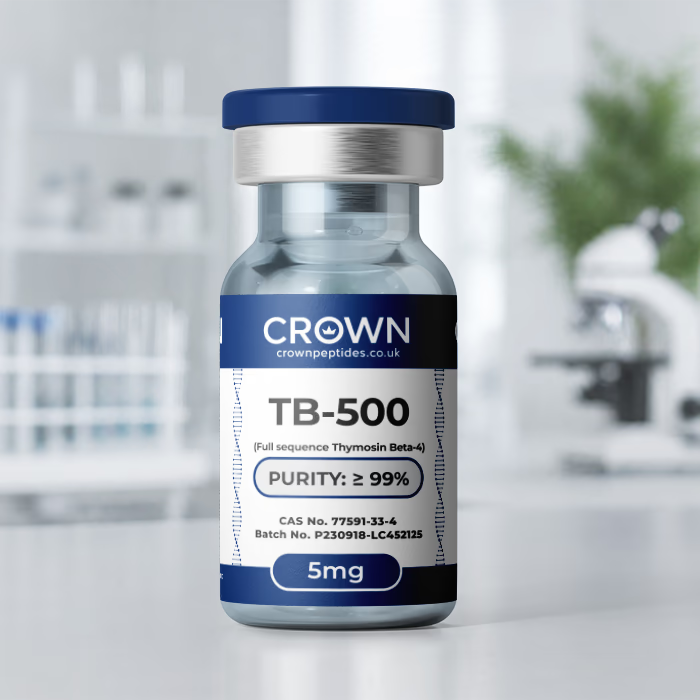
TB-500 peptide UK is Crown Peptides' Thymosin Beta-4-related research peptide, supplied in 5mg and 10mg vials for laboratory research into actin-sequestering biology, cell migration and angiogenesis.
Supplied for laboratory research purposes only — not for human consumption or for medical, veterinary or diagnostic use.
Almost every cell in the body already carries thymosin beta-4, a naturally occurring 43-amino-acid peptide first sequenced by Allan Goldstein's group from calf thymus extracts. Its best-known role is binding monomeric (G-) actin, the building block of the cell's internal scaffolding. TB-500 is the name used for thymosin beta-4 supplied for laboratory research, and the Crown Peptides specification matches the full 43-residue sequence.
Also known as: TB 500, TB500, Thymosin Beta-4, Thymosin β4, Tβ4.
The name TB-500 is used across the research supply market, and it is not always used consistently. Some suppliers use it for shorter fragments built around the actin-binding region, while others use it for the full peptide. Crown Peptides TB-500 matches the full 43-amino-acid thymosin beta-4 sequence, with a molecular weight of 4963.49 g/mol, and every batch's identity is confirmed by mass spectrometry on its certificate.
Thymosin beta-4 is one of the most abundant peptides inside cells, especially in platelets and white blood cells, and it is released at sites of tissue injury in experimental models. That combination, a natural role in actin regulation plus release where tissue is damaged, is why it has been studied so widely in cell-migration, angiogenesis and tissue-response research. It is often researched alongside BPC-157, and the full research story is covered in the TB-500 research guide.
Thymosin Beta-4-related research includes actin sequestration, cell migration, angiogenesis, wound-healing models and tissue-response biology, with the actin-binding domain itself identified as the region driving angiogenic activity in experimental models (Learn more). Because actin dynamics influence cell movement and structural organisation, the peptide has been studied in epithelial, endothelial and connective-tissue models, alongside related tissue-repair peptides such as BPC-157 and KLOW. Researchers should distinguish the exact TB-500 material supplied from full-length endogenous thymosin beta-4 where the product specification differs.
A resting cell keeps much of its actin as single subunits rather than filaments, and thymosin beta-4 is the main thing holding them back. Each molecule grips one monomer, which then cannot join a filament, and concentrations may approach 0.5 mM in some cell types. A crystal structure published in 2004 showed how: the chain caps both ends of the actin subunit, with the LKKTETQ motif at residues 17 to 23 sitting at the centre of the contact (Learn more).
Release is handled by profilin, whose binding site on actin overlaps slightly with thymosin beta-4’s. Profilin passes monomers to growing filament ends, so the pair act as reservoir and delivery service, which matters to migration studies because a moving cell builds filaments fast at its leading edge.
One of the most cited studies, published in the Journal of Investigative Dermatology in 1999, used a rat full-thickness wound model. Thymosin beta-4 increased re-epithelialisation by 42% over controls at day 4 and by up to 61% at day 7, with more collagen deposition and new blood-vessel growth in the treated wounds (Learn more).
An NIH group then turned to hair. Thymosin beta-4 stimulated hair growth in normal rats and mice, and follicle keratinocytes originating in the bulge, the stem-cell niche, expressed it in step with the hair cycle. Isolated rat whisker-follicle keratinocytes migrated and differentiated more at nanomolar concentrations and secreted more of the matrix enzyme MMP-2 (Learn more).
In 2004, a study in Nature showed that thymosin beta-4 forms a complex with PINCH and integrin-linked kinase, activating the survival kinase Akt. In a mouse coronary-ligation model it improved early heart-muscle cell survival and cardiac function (Learn more). Paul Riley’s London group reported in 2007 that the peptide stimulated outgrowth from quiescent adult epicardial explants, and that cardiac knockdown disrupted coronary vessel development (Learn more). A 2011 follow-up found that priming mice before an infarct let Wt1-positive epicardial cells give rise to a small number of new cardiomyocytes.
Other laboratories added important caveats. Lineage tracing by William Pu’s team found that giving the peptide only after infarction thickened the epicardium and raised capillary density, yet produced no epicardium-derived heart muscle. Full knockout mice made in San Diego also developed normal hearts and coronary vessels (Learn more).
Thymosin beta-4’s first four residues have a research career of their own. In 1989 a French team purified the acetylated tetrapeptide Ac-Ser-Asp-Lys-Pro from fetal calf bone marrow as an inhibitor of haematopoietic stem-cell proliferation (Learn more). Kidney studies later showed meprin-α making the first cut in the parent peptide and prolyl oligopeptidase then releasing Ac-SDKP.
Its removal is just as interesting. Angiotensin-converting enzyme degrades Ac-SDKP, and in eight healthy volunteers a single exposure to the ACE inhibitor captopril raised plasma Ac-SDKP about 5.5-fold. Rodent studies of hypertensive heart and kidney damage have since examined Ac-SDKP as a brake on collagen build-up. The parent peptide has its own fibrosis literature in heart, liver and lung models, which raises the question of which effects belong to the whole chain and which to its fragment.
RegeneRx Biopharmaceuticals, where Allan Goldstein has served as board chairman and chief scientific adviser, took thymosin beta-4 into three formulations, and the record is mixed. The RGN-259 eye drop went through three Phase 3 ARISE dry-eye trials in more than 1,600 people; none met its pre-specified co-primary endpoints. Its Phase 3 neurotrophic keratopathy trial, SEER-1, closed early with only 18 patients: 6 of 10 on the peptide had complete corneal healing at four weeks against 1 of 8 on placebo, a difference that fell just short of significance by Fisher’s exact test.
The RGN-137 topical gel met its safety endpoints in 72-patient Phase 2 trials in pressure and venous stasis ulcers, without statistically significant healing differences from placebo. The injectable RGN-352 completed Phase 1 work in healthy volunteers before its Phase 2 heart-attack trial was put on FDA clinical hold in 2011 over a contract manufacturer’s compliance. No thymosin beta-4 medicine has been approved.
Compound-level reference data. Batch-specific results appear on the Certificate of Analysis.
Work out concentration with the peptide calculatorCrown Peptides TB-500 / Thymosin β4 is supplied for controlled laboratory research with batch-specific analytical documentation. High-Performance Liquid Chromatography (HPLC) can assess chromatographic purity, while Mass Spectrometry provides molecular information used to support identity verification. The batch-specific Certificate of Analysis is the definitive source for the exact purity result, identity data and analytical specification of the material supplied.
Researchers working with TB-500 may also be interested in BPC-157, BPC-157 + TB-500, KLOW, GHK-Cu and KPV — other tissue-repair and cell-migration research peptides studied in related research areas.
At Crown Peptides, TB-500 means synthetic thymosin beta-4 matching the complete 43-amino-acid sequence (C212H350N56O78S, 4963.49 g/mol), sold as freeze-dried powder in 5mg and 10mg vials. Listings also spell it TB 500 or TB500, and each batch’s mass spectrometry result confirms the full-length chain.
Allan Goldstein’s laboratory pulled it out of thymosin fraction 5, a calf thymus extract, and Low, Hu and Goldstein published the full bovine sequence in 1981. At that stage it was assumed to be a thymic hormone. The actin connection came a decade later, when a platelet peptide named Fx, already known to sequester actin, proved to be the same molecule.
It describes binding that takes actin subunits out of circulation without destroying them. Thymosin beta-4 locks each monomer away so that it cannot join a filament, then gives it up when profilin or filament-building machinery competes for it. Microinjected into cultured cells in 1992, the synthetic peptide thinned stress fibres in proportion to the amount added.
The evidence says it does, even though it has no signal sequence for conventional secretion. Released peptide has been linked in experimental studies to the integrin-linked kinase pathway in heart cells, to endothelial migration, and to production of Ac-SDKP from its first four residues. How it leaves cells remains an open question.
Angiotensin-converting enzyme is the main enzyme that breaks Ac-SDKP down. Blocking it lets the tetrapeptide accumulate, and a 1996 crossover study in healthy volunteers recorded a rise of around 5.5-fold after captopril. Kidney experiments later showed that blocking meprin-α, the enzyme that makes the first cut in thymosin beta-4, stopped captopril from raising Ac-SDKP, tying the fragment back to its parent peptide.
The results were mixed rather than clear-cut. Across the three ARISE dry-eye trials the pre-specified co-primary endpoints were missed, while individual measures such as ocular grittiness reached significance at certain time points. In the small SEER-1 neurotrophic keratopathy trial, healing rates favoured the peptide, but too few patients enrolled to settle the question.
Only under narrow conditions, according to current evidence. Riley’s group saw a modest number of new cardiomyocytes from Wt1-positive epicardial cells in mice treated before the infarct. When Pu’s team gave the peptide after the injury, lineage tracing found more capillaries and a thicker epicardium but no epicardial cells becoming heart muscle.
Surprisingly, they can. Global knockout mice made in 2012 were born at expected ratios with normal hearts and coronary vessels, and mice lacking the gene only in the heart also showed no defect. Earlier RNA-knockdown mice had died mid-gestation with vessel problems, so the gap between the two approaches has become a debate in its own right, and a reminder to check how a model was made.
WADA’s growth factor section names thymosin beta-4 and its derivatives, with TB-500 given as an example, and they are prohibited at all times. The best-known case followed the Essendon supplements affair: in 2016 the Court of Arbitration for Sport found 34 current and former AFL players guilty over thymosin beta-4 use in 2012. In racing, a 2012 Hong Kong LC-MS method detected the acetylated LKKTETQ fragment and its metabolites in horse urine and plasma.
Length is the challenge. A chain this long is assembled one coupling at a time, and every step offers a chance to skip a residue or stop early, so deletion and truncated sequences are the impurities to look for. They elute close to the main HPLC peak and betray themselves by mass: a missing lysine leaves a product 128 Da light. Purity and identity results for each batch are on the Lab Reports page.
In content, it is: the same peptide and specification, twice the weight. The 5mg fill suits cell migration or tube-formation assays run at nanomolar concentrations, while the 10mg fill means fewer reconstitutions for longer animal series. Both are sold singly or in boxes of 5 and 10, saving 15% and 25% per vial, and the peptide calculator gives the concentration for any diluent volume.
GLOW and KLOW each contain 10mg alongside a larger share of GHK-Cu, and the Wolverine Stack pairs 5mg or 10mg with an equal weight of BPC-157. Standalone vials remain the right choice for single-peptide control arms. Our BPC-157 vs TB-500 guide and the TB-500 research guide go further.
Every batch is published openly — identity, purity and batch number, with no account needed.
Supplied for laboratory research purposes only — not for human consumption or for medical, veterinary or diagnostic use.
Each batch undergoes internal analytical verification using chromatographic and spectrometric methods prior to lyophilisation.
• HPLC Analysis
• Mass Spectrometry Confirmation
• Batch Traceability
By purchasing this product you confirm that you are a qualified researcher and that this compound will be used exclusively for laboratory research purposes.
This product is not intended for diagnostic or therapeutic use.
Any human or medical use is strictly prohibited.
Store in a cool, dry, secure and sterile environment away from any unauthorised persons or children.
Disclaimer: All products are sold strictly for laboratory research purposes only. Not for human or veterinary use, consumption, therapeutic, or diagnostic application. None of our products are medicines, and none are presented as such. By purchasing, you confirm you are a qualified professional and legally permitted to handle these materials in compliance with all applicable laws and regulations. Misuse, resale for unauthorised purposes, or unlawful application is strictly prohibited. Crown Peptides UK disclaims all liability for improper use, handling, or regulatory non-compliance.